What does Google want from local content in 2027? Going by what Google published in 2026, it wants pages built from real experience that people find unique and useful. Google's guide to optimizing for generative AI search says content people find "unique, compelling, and useful" will likely do more for a site's presence in AI search over the long run than any other suggestion in that guide. Google contrasts that with what it calls commodity content, which it says is often based on common knowledge that could come from anyone.
Google also spent 2026 moving booking and calling into its local results, and it gave owners better tools to measure what search sends them. We expect both changes to shape how home service companies win work from search in 2027. Our plan for clients rests on three things: service pages that answer real questions in your team's own words, city pages with real local proof, and measurement built on calls and booked jobs.
ASP is a done-for-you marketing agency for HVAC, plumbing, electrical, roofing and remodeling companies. This post walks through what Google has published about content quality, longer questions, city pages, booking and measurement, and what we would do about each one. We checked every source on November 23, 2026. For our wider view of the year ahead, read our SEO and AEO predictions for 2027.
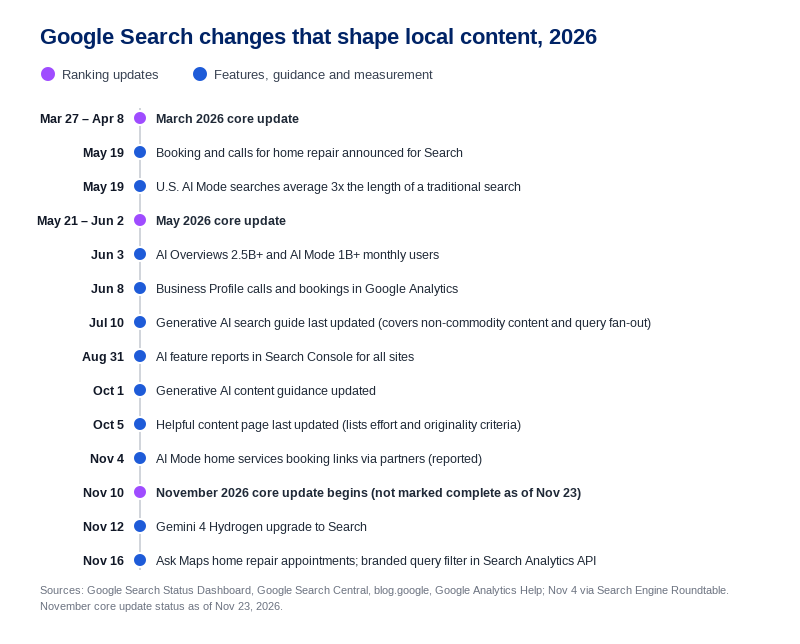 Dates of the 2026 Google Search changes covered in this post. All are from Google's own posts, documentation and status pages, except Nov 4, which comes from Search Engine Roundtable's report.
What Does Google Mean by Non-Commodity Content?
Google's generative AI search guide, last updated July 10, 2026, draws a line between two kinds of content. Its example of commodity content is a post called "7 Tips for First-Time Homebuyers," which Google says "typically adds little unique insight for readers." Its example of non-commodity content is a post called "Why We Waived the Inspection & Saved Money: A Look Inside the Sewer Line." Google says that kind of content provides "unique expert or experienced takes that go beyond common knowledge and the ordinary."
Both of Google's examples are about homes, and the same split shows up on home service websites. A post titled "5 Signs Your AC Needs Repair" could sit on almost any HVAC site in the country without changing a word. A post where your lead tech explains what they check first on a no-cool call, and why, could only come from your company. In our view, the second kind of page is what Google is describing.
The guide also tells site owners how to get there. It says, "Create the content yourself based on what you know about the topic, and consider what in-depth experience you can bring to your content." It also says, "Don't just recycle what others on the internet have already said, or could easily be produced by a generative AI model." When it makes sense, Google suggests supporting your text "with high-quality, relevant images and videos on your pages."
Google does not treat AI search as a separate discipline. The guide says, "From Google Search's perspective, optimizing for generative AI search is optimizing for the search experience, and thus still SEO." It explains that Google's AI features "are rooted in our core Search ranking and quality systems." Those features reach a lot of people. In June 2026, Google said, "AI Overviews now has over 2.5 billion monthly active users, while AI Mode has surpassed one billion monthly users." If the acronyms get confusing, our comparison of SEO, PPC, AEO and GEO explains how they fit together.
Key Takeaway: Google's own 2026 guide asks for content built from first-hand experience, so build service pages from what your techs know instead of repeating what every other site already says.
What Google's Helpful Content Page Says About Effort and Originality
Google updated its page on creating helpful, people-first content on October 5, 2026. The page now includes criteria from Google's Search Quality Evaluator Guidelines, which search raters use to assess page quality. The page says one of the most critical factors is the quality of the main content, "specifically how effectively it allows the page to achieve its purpose and provide a satisfying user experience."
Two of the criteria apply directly to local content. On effort, the page says, "Effort: The extent to which human work went into creating the content or the systems powering it." It also describes the low end: "Conversely, automatically generating pages from feeds or using generative AI to produce large amounts of text without manual oversight or curation represents little to no effort." On originality, it says, "Originality: The extent to which the content offers unique, original information or perspectives that aren't already available on other websites."
Google is careful about what raters do. The page says, "Search raters have no control over how pages rank. Rater data is not used directly in our ranking algorithms." These criteria describe what Google considers quality, and they are not a ranking checklist. In our view, they are still the clearest public description of the page Google wants you to build.
The same page keeps its older self-check questions. It asks, "Does the content provide original information, reporting, research, or analysis?" It also asks, "Does the content provide substantial value when compared to other pages in search results?" Another question asks whether your content clearly shows first-hand expertise and a depth of knowledge. Under the heading "Avoid creating search engine-first content," Google asks whether you are "using extensive automation to produce content on many topics." It also asks whether you are "producing lots of content on many different topics in hopes that some of it might perform well in search results."
Does Google allow AI-assisted content?
Google does not ban AI tools. Its guidance on using generative AI content, updated October 1, 2026, draws the line at volume without value. It says, "However, using generative AI tools or other similar tools to generate many pages without adding value for users may violate Google's spam policy on scaled content abuse." It also says, "It is critical to manually factcheck and review all AI-generated content for accuracy and trustworthiness before publishing."
Where the expert insight comes from
Your techs and office staff answer customer questions every day, and in our view that knowledge is the part of your content a competitor can't copy. At ASP, our approach is a short recorded conversation with the owner or a lead tech. We ask something like, "Hey, what's the question customers ask you most on a water heater call?" Then we build the page around the answer, in their words, and add photos or a clip from real jobs where they help the reader.
Key Takeaway: Google's helpful content page describes effort as human work and originality as perspectives not already available elsewhere, so use AI as a helper, have a person check every fact and build each page from your own team's knowledge.
Why Longer Questions Change How You Build Service Pages
People in the U.S. are asking Google longer questions in AI Mode. Google published its AI Mode insights on May 19, 2026. It said, "While we're seeing growth in both short and long queries in AI Mode, the average AI Mode search is triple the length of a traditional Search query." In the same post, Google said its new AI features are "the leading reason why we're seeing queries at an all-time high."
For scale, Google said in May 2025 that it sees "more than 5 trillion searches on Google annually." We did not find a newer total from Google. A homeowner who once typed "furnace repair" might now ask about the noise their furnace makes at night, how old the unit is and whether it's worth fixing. A question like that tells you what the person is worried about before they ever call.
How Google answers a long question
To answer questions like that, Google's AI features use a method Google calls query fan-out. The generative AI search guide gives this definition: "A set of concurrent, related queries generated by the model to request more information and fetch additional relevant search results to address the user's query." Its example starts with "how to fix a lawn that's full of weeds" and fans out to related searches such as "best herbicides for lawns" and "how to prevent weeds in lawn." Google does not say how many related searches it runs.
On November 12, 2026, Google moved Search to Gemini 4 Hydrogen, which it called "the biggest model upgrade to Search yet." Google said, "Hydrogen's advanced reasoning supercharges our query fan-out technique in Search, connecting you to a broader range of helpful links than before." Google also said Search now runs simultaneous queries across all the relevant subtopics of a question. In our view, a page that covers the whole job a homeowner is asking about has more chances to match those related questions than a page built around one phrase.
Answer questions on the page that owns them
The tempting move is to build a new page for every question. Google's guide warns against that. It says creating separate content for every variation of how people search, including fan-out queries, "primarily to manipulate rankings or generative AI responses in Google Search violates Google's scaled content abuse spam policy." It adds, "This is also an ineffective long-term strategy, as a high quantity of pages doesn't make a website higher quality or more relevant to users."
Google also says you don't have to chase every phrasing. The guide says, "This means you don't have to worry that you don't have enough 'long-tail' keywords or haven't captured every variation of how someone might seek content like yours." So we use long questions to learn what customers worry about, and we don't treat them as a keyword list. Start with the questions your office hears on the phone and the ones your techs hear in the driveway. If a question fits a service you do, answer it on that service's page, in the words your customers use.
Our guide on how to rank in AI search goes deeper on getting a business into these answers. Google's guide also says special AI files are not needed for its search: "You don't need to create new machine readable files, AI text files, markup, or Markdown to appear in Google Search (including its generative AI capabilities), as Google Search itself doesn't use them." Our post on llms.txt for local businesses covers that topic in more depth.
Key Takeaway: Google says the average U.S. AI Mode search is three times the length of a traditional search, so answer real customer questions on the service page that owns them instead of building a page for each one.
Does Your City Page Pass the Swap Test?
In our experience, city pages are where a lot of home service sites cut corners. Google's spam policies say, "Doorway abuse is when sites or pages are created to rank for specific, similar search queries." One of the examples Google lists is "Having multiple domain names or pages targeted at specific regions or cities that funnel users to one page." On scaled content abuse, the same page says, "This abusive practice is typically focused on creating large amounts of unoriginal content that provides little to no value to users, no matter how it's created."
Google's doorway example is about pages that funnel users to one page. The policy does not say that every city page breaks the rules. A city page with real local substance helps the person who lands on it, and that is the kind of page we aim to build.
Google ran core updates in March, May and November of 2026. The March core update was complete as of April 8, and the May core update was complete as of June 2. Google released the November 2026 core update on November 10 and said, "The rollout may take up to 2 weeks to complete." As of November 23, 2026, the status page had not posted that the rollout was complete.
After the March update, one local marketing agency wrote that if a site had 15 or 20 near-identical location pages, with just the city name swapped in, those pages likely lost rankings in March 2026. That is one agency's read, not controlled data. Another local marketing firm that studied city pages noted that there is no public count of how many city pages fell.
How the swap test works
We run a simple swap test on every city page. That second firm describes the same test in its write-up. First, swap in a different town's name and reread the page. If every sentence still reads true, nothing on the page belongs to that town. Next, swap in a competitor's name and read it again. If it still reads true, nothing on the page belongs to your company either.
Ask these four questions about each city page you have:
- Does the page name places in that area, such as neighborhoods, ZIP codes or landmarks?
- Does it mention real jobs your team has done there, without exposing customer information?
- Are the photos taken in or around that area?
- Would the page become false if you swapped in another town or a competitor's name?
The first three come from the fixes the first agency recommended, and the last one is the swap test. If a page fails, it needs real local substance, and a new city name won't fix it. For heating and cooling companies, our HVAC SEO guide goes further on building pages that earn their place.
Why real businesses may have the edge
An SEO agency's analysis of the March 2026 update covered 2,076 domains. It said, "This data presents a clear divide: the top of the winner list is almost entirely 'the company that owns the thing.'" It also found that the top of the loser list was almost entirely "the platform people use to talk about the thing." That analysis does not mention home services, and it covers the March update, not May or November. In our view, a local company that does the work and shows it on its own pages fits the "company that owns the thing" side of that split.
Key Takeaway: Google's spam policy names city pages that only funnel visitors to one page, so give every city page local jobs, places and photos that would make it false for any other town.
Google Is Moving Booking and Calling Into Local Results
In 2026, Google kept adding ways for a homeowner to book or call a business from its results. At its I/O event on May 19, Google said it was expanding agentic booking in Search to local experiences and services. In Google's description, you share your criteria, and Search pulls together "the latest pricing and availability with direct links to finish booking through the provider of your choice." Google also said, "And for select categories like home repair, beauty or pet care, you can ask Google to call businesses on your behalf." Google said these features would roll out to everyone in the U.S. that summer.
On November 4, 2026, a Google product leader posted on X that AI Mode now has direct links to research and book home services through partner platforms, as reported by Search Engine Roundtable. The partners named were Angi, Thumbtack, Housecall Pro and Jobber, with ServiceTitan coming soon, and the announcement said the feature was available in the U.S. ASP is a Housecall Pro Affiliate. If you already use field service software, ask your provider whether your account can appear in AI Mode.
Google Maps moved the same way. On November 16, 2026, Google said, "Now, with new agentic capabilities, you can choose to have Ask Maps find beauty, pet care, auto and home repair appointments online and call local businesses for you." Google said appointment finding is launching first in the U.S.
What this means for your pages and profile
Google's generative AI search guide says, "Using products like Merchant Center (such as Merchant Center feeds) and Google Business Profiles can help your products and services to be visible in both AI responses and other Google Search results." Google's main-content criteria also list "Interactive features: Built-in functionality such as calculators, online tools, games, or search functionality." In our view, a working booking form or a cost estimator on a service page fits that description.
Not every change helps the business. Search Engine Roundtable reported on November 10, 2026, that "Google is testing removing the action buttons, reviews, photos, etc from the AI Overview version of the local pack." We found no Google announcement of that test. Google also said on November 23, 2026, that people will see "more personally relevant responses in AI Overviews and AI Mode, tailored to your recent search context," per its Search announcement. So the AI answer you see when you search your own service may not match what a homeowner sees.
We expect more homeowners in 2027 to book or call from Google's results without opening a website. That is our expectation, and Google has not said it. Plan for it by keeping your Business Profile accurate, making your own booking path easy to use and tracking where each call and booking came from.
Key Takeaway: Google's 2026 launches point toward booking and calling from the results page, so keep your Business Profile accurate and make your own booking path easy for a homeowner to use.
How Should You Measure Local Content in 2027?
Google gave owners several new ways to measure search in 2026. Its Search Console reports for generative AI features were announced in June, and Google later added, "As of August 31, 2026, we've rolled out these insights to all websites worldwide." The reports show how often URLs from your site appeared in AI features such as AI Overviews and AI Mode, broken out by pages, countries, devices and dates. Google's announcement does not list clicks or queries among them.
Google's generative AI search guide also sets the entry rules. A page must be indexed and eligible to show in Google Search with a snippet. The guide also says a site must be included in Search generative AI features in Search Console to be eligible for those features. Check that setting on your property so you are not left out by accident.
On November 16, 2026, Google added a branded query filter to the Search Analytics API. Google said, "Group or filter your data by brandedClassification to compare branded and non-branded performance." Google notes this data is only available for eligible properties.
Calls and bookings now have a home in Google Analytics too. Since June 8, 2026, you can link Google Analytics with Google Business Profiles in the Admin panel. Google says you can "Access seven core GBP metrics directly in your reports: GBP interactions, calls, bookings, directions, website clicks, messages, and menus." Those metrics are available on a rolling six-month window.
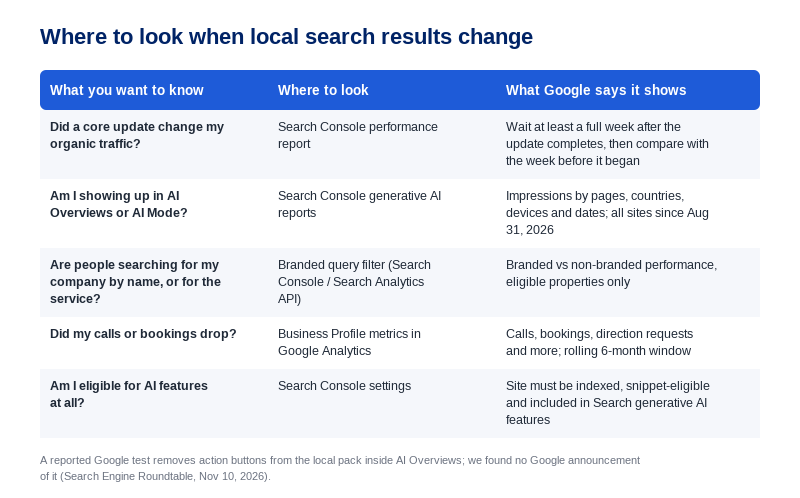 Match the question to the report before you change a page.
Timing is the last piece. Google's core updates page says, "We recommend waiting at least a full week after a core update completes before analyzing your site in Search Console." It also says, "After a week, try comparing this week with a week before the core update started rolling out; this way you'll be able to better pinpoint what exactly has changed." With the November update still open on November 23, that comparison has to wait.
At ASP, we judge content the way we judge every channel: by the calls and booked jobs it brings in, measured as cost per booked job. If organic clicks hold steady while Business Profile calls fall, we look at how Google's results look for your search before we rewrite good pages. If you're weighing paid AI visibility work, our post asking does GEO work? is worth reading first.
Key Takeaway: Google now reports AI feature impressions, branded versus non-branded searches (for eligible properties) and, once you link Google Analytics, Business Profile calls in tools you already have, so measure content by booked jobs and tell a content problem from a results-layout problem before you change anything.
What Should a Home Service Owner Do First?
If you only have time for a few steps before 2027, take them in this order:
- Check your Search Console setup. Confirm your site is included in Search generative AI features, then open the AI features report and note which pages appear.
- Link Google Analytics to your Business Profile. Start tracking calls, bookings and direction requests next to your website data.
- Rewrite your top three service pages from a real conversation. Record your lead tech answering the questions customers ask most, and build each page around those answers.
- Run the swap test on every city page. Add local jobs, places and photos to the pages that fail, or fold them into a stronger page.
- Make booking easy. Keep your Business Profile accurate, and make sure a homeowner can call or request service from any service page.
- Wait before judging the November update. Once Google posts that the rollout is complete, wait at least a full week, then compare against the week before it started.
None of this comes with a guarantee, and no one outside Google controls what its results show. What a home service company can control is whether its pages show real experience, whether its city pages hold up to the swap test and whether it can see which searches turn into booked jobs. If you want ASP to run that work for you every month, book a strategy call.
Frequently Asked Questions
Does Google penalize content because AI helped write it?
Should I update the dates on old blog posts so they look fresh?
Should I build a separate page for every question homeowners ask?
Should I wait for the November 2026 core update to finish before improving my site?
If my calls dropped, is my content the problem?
Does my Google Business Profile affect AI answers?
Does Google's Preferred Sources feature help a local business rank?
Do I need an llms.txt file to show up in Google's AI answers?

Joel Keith
CEO and Partner at ASP
Joel Keith is CEO and a partner at ASP, a growth-systems marketing agency for home service operators. He is a marketing operator who has spent years inside home service companies, building and refining the systems ASP now runs for clients. ASP is a Housecall Pro Affiliate.
Ready to Put This Into Action?
ASP can help you implement these strategies and build a marketing system that drives measurable growth.