
llms.txt is a plain text file, written in Markdown, that a website places at /llms.txt. It gives AI tools a short summary of the site and links to its most useful pages. For a local business, llms.txt is not a visibility strategy worth paying for. Google says its Search ignores the file. The crawler documentation from OpenAI and Perplexity tells site owners to manage access through robots.txt and does not say either company reads a business's llms.txt.
That is why ASP doesn't sell llms.txt as a GEO product. This post covers what the file is and what the major platforms have said about it. It also explains why we don't charge for it, and which work gives a home service business a better chance of being described correctly by AI tools.
What Is llms.txt?
The proposal came from Jeremy Howard, who published it at llmstxt.org on September 3, 2024. It suggests "adding a /llms.txt markdown file to websites to provide LLM-friendly content." The reasoning is that a web page carries navigation menus, scripts and ads, so an AI tool has to dig the useful text out of all that code. A tidy Markdown file gives the tool a shortcut: a brief description of the site, some guidance, and links to the pages that matter.
The examples the proposal leads with come from software. It describes a coding agent that "fetches a library's documentation to get an API call right." The proposal site also says "llms.txt files are used most heavily for software documentation, where coding agents follow them to find API references and tutorials." A developer's AI assistant benefits from a clean map of a large set of reference pages, and the proposal site notes that documentation platforms now generate the file automatically.
A plumbing or HVAC website is a different kind of site. It usually has a home page, a handful of service pages, a service area page and a contact form. A site that small is easy to move through by following its normal links. The v2 proposal says the same structure can work for "a business outlining its structure and policies." On a small home service site, though, the file mostly restates what the pages already say.
Key Takeaway: llms.txt is used most heavily for software documentation, and on a typical home service website it mostly repeats a summary of pages that already exist.
What Google, OpenAI and Perplexity Have Said About llms.txt
Google has been the most direct. Its guide to optimizing for Google's AI features says: "You don't need to create new machine readable files, AI text files, markup, or Markdown to appear in Google Search (including its generative AI capabilities), as Google Search itself doesn't use them." The same guide says publishing an llms.txt file for other services is fine, and that doing so "will neither harm nor help your site's visibility or rankings in Google Search, as Google Search ignores them."
The guide takes the same position on schema. It says "Structured data isn't required for generative AI search, and there's no special schema.org markup you need to add." Google still recommends structured data as part of normal SEO, because it helps a page qualify for rich results. That is a different job from getting quoted in an AI answer.
Google also spells out what a page needs to appear in its AI answers. According to its documentation on AI features, "To be eligible to be shown as a supporting link in AI Overviews or AI Mode, a page must be indexed and eligible to be shown in Google Search with a snippet, fulfilling the Search technical requirements." The page adds, "There are no additional technical requirements."
OpenAI and Perplexity describe their crawlers in their own help docs. OpenAI's crawler page explains that "OAI-SearchBot is used to surface websites in search results in ChatGPT's search features," and site owners control it through robots.txt. Perplexity's crawler page recommends "allowing PerplexityBot in your site's robots.txt file" for sites that want to appear in its results. Both pages link to the company's own llms.txt as an index of its documentation. Neither page says the company reads a business's llms.txt to decide which companies to show or recommend.
The proposal site says that after two years of adoption, thousands of sites publish the file and "Chrome's Lighthouse audits sites for one as part of its agentic browsing checks." A site audit tool checking for a file is a separate question from whether a search product uses it. On that question, Google's Search guidance says Search ignores the file.
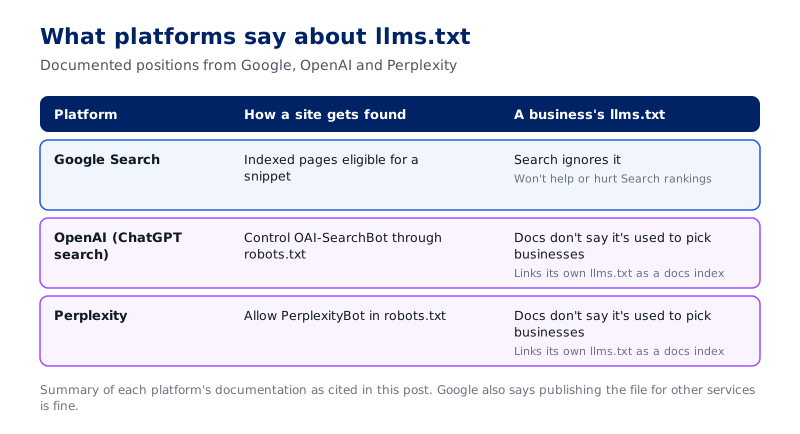
Read the right-hand column: neither OpenAI's nor Perplexity's crawler docs say they use a business's llms.txt to pick which businesses to show.
Key Takeaway: Google states that its Search ignores llms.txt, and OpenAI's and Perplexity's crawler documentation points site owners to robots.txt, so none of these pages describes the file as a way to earn a mention.
Why ASP Doesn't Sell llms.txt as a GEO Strategy
Generative engine optimization, or GEO, is the work of being described correctly when someone asks an AI assistant like ChatGPT or Perplexity who to call. Our guide to GEO covers the full definition. The question to ask of any GEO tactic is whether there is evidence it changes what an assistant says about a business.
For llms.txt, that evidence is missing. Google has said its Search does not use the file, and OpenAI's and Perplexity's crawler documentation does not say they use it to pick businesses. Chat assistants also don't publish anything like an impressions report for a local business, and the same question can return different answers on different days. A vendor who charges a monthly fee for an llms.txt file is charging for something with no documented effect and no way to measure it.
Our position is written into our service pages. Our AEO page says we do not publish an llms.txt file as an AEO tactic and do not sell schema as a way into AI answers. Our GEO page says there is no GEO package or line item, because the work that helps sits inside what we already do for Business Profiles, reviews, listings and content. The same test applies to any search shortcut that a platform itself has not endorsed, which we cover in Real SEO vs. Fake SEO.
None of this makes the file harmful. Google says it will neither help nor hurt your rankings in Google Search, and thousands of sites publish one, according to the proposal site. Our own site publishes one for tools that read it; we just don't sell it as a way into AI answers. If your web developer wants to add one, that is a reasonable choice. Just don't treat it as the reason an AI assistant will recommend you, and don't pay a recurring fee for it.
Key Takeaway: An llms.txt file won't hurt your Google Search rankings, but paying for it as a GEO service means paying for a tactic that Google says its Search ignores and that no one can measure.
What Helps a Local Business Show Up in AI Answers Instead?
Search engines and AI assistants build answers from public information about your business. The work that helps is the work that makes that information complete, accurate and easy to check. Google's AI guide points the same way. It says "Using products like Merchant Center (such as Merchant Center feeds) and Google Business Profiles can help your products and services to be visible in both AI responses and other Google Search results."
The guide also warns against shortcuts: "While terms like Answer Engine Optimization (AEO) or Generative Engine Optimization (GEO) are common online, many suggested "hacks" aren't effective or supported by how Google Search actually works." We put the time for a home service business into these areas:
- A complete, current Google Business Profile. Categories, services, hours, service area and photos should stay accurate over time. Google's local ranking help page says "Businesses with complete and accurate info are more likely to show up in local search results."
- Reviews in steady volume. The same page says "More reviews and positive ratings can help your business's local ranking." Recent reviews also describe the business as it runs today.
- One name, address and phone number everywhere. Mismatched listings create two versions of your business in public. Our guide to NAP consistency for local SEO covers why those details have to match.
- Service pages that answer real questions. Explain what the job involves, where you do it, what drives the cost and what goes wrong. Thin pages give a search engine or an assistant nothing to quote.
- First-hand experience on the page. Google's guide says "a first-hand review provides a unique perspective based on personal experience, whereas a summary of existing content simply restates information already available elsewhere." The prices, failure modes and judgment calls your techs see every week are details other sites cannot copy.
- A site that crawls cleanly. A page has to be indexed and eligible for a snippet before it can appear as a supporting link in Google's AI features.
None of these moves is new, and none is specific to AI. They are the same signals that help a homeowner check you out before calling. Our guide on how to rank in AI search goes deeper on the documented moves, and our local SEO playbook covers the map pack side.
Key Takeaway: The work that helps AI tools describe a local business correctly is the same Business Profile, review, listing and content work that already drives local search.
How Should You Judge an AI Visibility Pitch?
If an agency pitches you an llms.txt file, an "AI-ready" markup package or a special AI layer, ask three direct questions before you sign anything. Each one is easy for a trustworthy vendor to answer.
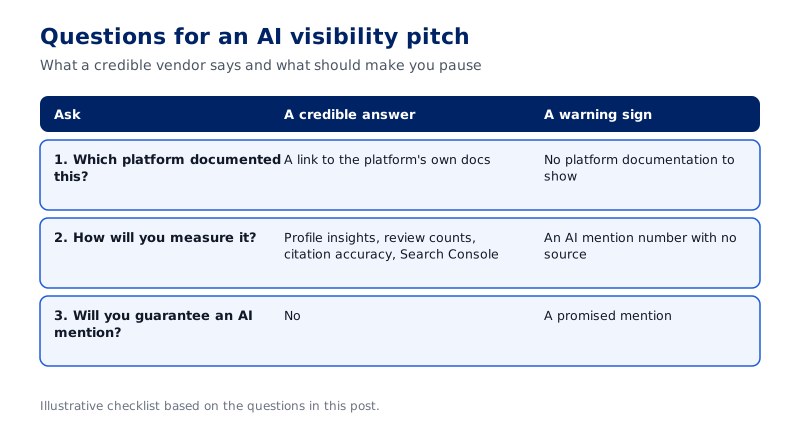
Keep this checklist next to any proposal that bills for an AI file, AI markup or an AI layer.
Start by asking which platform has documented the tactic, and ask for the link. Google's guidance is public, and it names AI text files and Markdown files as things its Search does not use. A vendor who can't point to a platform's own documentation is selling a guess.
Then ask how they will measure the result. Our GEO page lays out what can be measured today: Business Profile insights, review counts, citation accuracy and Search Console data. It also lists what cannot be measured, such as how often an assistant names you or a competitor. A pitch that reports a precise "AI mention" number for a local business should explain exactly where that number comes from.
Finally, ask whether they will guarantee an AI mention. The accurate answer is no, because no one controls what these systems say. If you want the research side of this question, we walk through what the evidence shows on GEO.
Key Takeaway: A credible AI visibility pitch names its source, explains how it measures results and declines to guarantee a mention.
What We Tell Owners About llms.txt
If you ask us whether your business needs an llms.txt file, we will point you to what Google has published. Google says its Search ignores the file, that it will not hurt or help your rankings there, and that there is no special markup to add for AI answers. OpenAI and Perplexity document robots.txt as the way to manage their crawlers. We would rather spend your budget on the public record that people and machines both read: your Business Profile, your reviews, your listings and your service pages.
That work is less exciting to pitch than a new file, but it rests on guidance the platforms have published. It also keeps paying off in regular local search whether or not an AI assistant ever names you.
Frequently Asked Questions
What is llms.txt?
Does Google use llms.txt?
Do ChatGPT or Perplexity use llms.txt to recommend local businesses?
Is it harmful for my business website to have an llms.txt file?
Why doesn't ASP sell llms.txt as a GEO service?
Do I need special schema markup to show up in AI answers?
What helps a local business show up accurately in AI answers?

Joel Keith
CEO and Partner at ASP
Joel Keith is CEO and a partner at ASP, a growth-systems marketing agency for home service operators. He is a marketing operator who has spent years inside home service companies, building and refining the systems ASP now runs for clients. ASP is a Housecall Pro Affiliate.
Ready to Put This Into Action?
ASP can help you implement these strategies and build a marketing system that drives measurable growth.