The difference between SEO, AEO and GEO is where your business shows up when someone looks for help. SEO earns a place in Google's regular results and the map pack. AEO earns a place inside Google's own answers, such as AI Overviews, AI Mode and featured snippets. GEO works on how standalone AI assistants like ChatGPT and Perplexity describe your business when someone asks who to call.
PPC is the fourth option, and it is the only one where you pay for each click or lead. The other three are earned, and they share most of the same groundwork. This guide opens with the tradeoff between speed and ad spend, then covers what each discipline is, what it costs in time and money, how fast it works, and how to decide where to start. Two charts show that tradeoff along the way. The examples lean toward home service businesses.
Do You Need Leads Now or Lower Lead Costs Later?
One of the biggest factors in where to start is how fast you need more leads. Paid ads are the quickest way to reach buyers, because you are buying the placement directly, and the leads stop when the spending does. SEO, AEO and GEO need no ad spend, but they take labor and time. SEO and AEO take months to build, nobody can verify a timeline for GEO, and organic results keep working after they start, provided someone keeps them accurate.
The chart below shows where each one sits on speed and ad spend. A second chart, at the start of the section on how fast each one works, shows what happens to lead flow from paid and organic work when the ad budget stops.
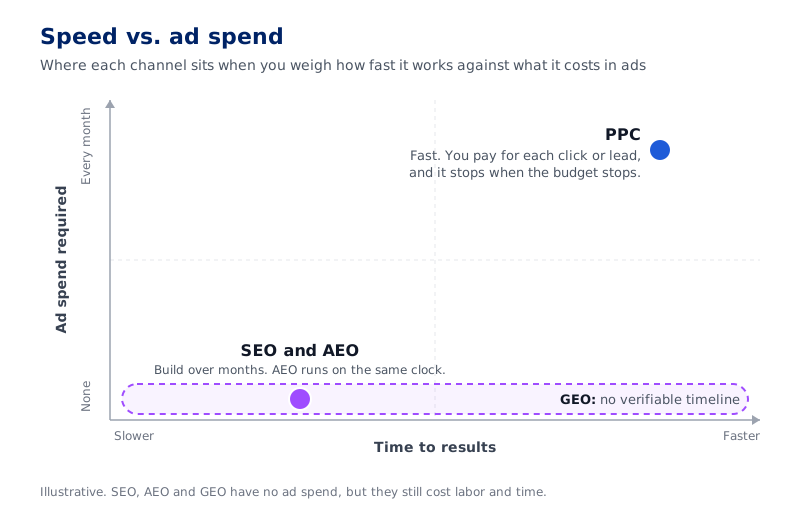
PPC needs ad spend every month to deliver fast results; the organic channels need none.
Key takeaways for choosing where to start:
- Needing booked jobs this month points to paid search first, with organic work growing underneath it so you are not paying for every lead indefinitely.
- A steady lead flow with a rising cost per lead is the signal to shift more weight toward SEO, since organic results keep paying back once they start.
- Treat a separately priced AI package built on special files or markup with caution, since AEO and GEO mostly run on the same pages, reviews and listings as SEO.
- If your Business Profile, reviews or listings are messy, cleaning them up first helps your map-pack rankings and corrects the facts AI assistants read.
- Judge every channel by the booked jobs it produces, not by clicks or rankings alone.
What Is the Difference Between SEO, AEO and GEO?
Google's SEO Starter Guide says SEO "is about helping search engines understand your content, and helping users find your site." For a plumber or HVAC company, that means showing up in the map pack, in the organic results, and on the service page a homeowner reads before calling. It also covers the technical side, so Google can crawl and index every page you publish. Our home service SEO page lays out how we run that work and measure it against booked jobs.
AEO stands for answer engine optimization. It is the work of becoming the source that Google's answer features quote, including AI Overviews, AI Mode, featured snippets and People Also Ask. Google states that the best practices for SEO remain relevant for AI features in Search, and that there are no additional requirements to appear in AI Overviews or AI Mode. For that reason we treat answer engine optimization as SEO held to a higher bar, because a page has to be clear and trusted enough for Google to summarize it.
GEO stands for generative engine optimization. The term comes from a 2023 research paper that introduced GEO as a way to help content creators improve their visibility in generative engine responses. We use it for the chat assistants outside Google's results page, such as ChatGPT, Perplexity and Claude. For a local business, the practical work is keeping your public record accurate, which means your Business Profile, reviews, listings and website. Our guide to generative engine optimization covers the definition in more depth.
People use AEO and GEO loosely, and plenty of articles treat them as one thing. We draw the line by platform, with Google's own answer surfaces under AEO and standalone assistants under GEO. Keeping them apart keeps the evidence for each one separate, because each rests on a different mechanism, and it means our pages never tell you two different things. Our GEO page explains where that line sits and what nobody can measure yet.
Key Takeaway: SEO, AEO and GEO share most of their groundwork, and the main difference is which screen your customer is looking at when your business comes up.
Where PPC Fits Next to the Other Three
PPC stands for pay-per-click advertising. In Google Ads, cost-per-click bidding means you pay for each click on your ads. Local Services Ads charge differently. Google tells advertisers they pay only for leads related to your business and the services you offer, and the Local Services unit is shown prominently in search results when people look for those services in the areas you chose.
For most home service operators, PPC means three channels running together: Google Search Ads, Local Services Ads, and a small Meta retargeting budget. The biggest difference between PPC and the other three is what happens when you stop paying. Your ads stop showing when the budget runs out. Organic pages, answers and listings keep working after you stop adding to them, although they need upkeep to stay accurate.
Most established businesses end up running SEO and PPC side by side. The search terms that turn into booked jobs in an ad account also show you which organic pages are worth building next. Our PPC management page walks through how we audit and run those accounts. For the channel mix in more detail, read our guide to PPC advertising for home service businesses.
Key Takeaway: PPC is the only one of the four that buys placement directly, so it is the fastest lever and the first one to go quiet when spending stops.
What Each One Costs in Time and Money
We are not going to print price ranges here, because the real number depends on your market, your site and what is already broken. What we can lay out is where the money and the time go for each discipline. The split below is how we explain it to owners who ask.
- SEO: The cost is mostly labor and your time. Content that ranks comes from first-hand experience, so someone has to interview you or a senior tech. Technical fixes and new service pages get built over months.
- PPC: You pay two separate costs. Ad spend goes straight to Google or Meta, and management is a separate fee. A sensible budget works back from what a booked job is worth to you.
- AEO: At ASP, it has no line item of its own, because it runs on the same work as SEO. The added cost is a higher standard of writing and page structure.
- GEO: The cost is mostly the Business Profile, review and listing work a local SEO program already covers. For many businesses it adds little new spending.
Be cautious with anyone selling AEO or GEO as a separate package built around special files or markup. Google's guide to its generative AI features says you don't need to create new machine readable files, AI text files, markup, or Markdown to appear in Google Search. For ChatGPT, one real technical check costs almost nothing. OpenAI says sites that are opted out of OAI-SearchBot will not be shown in ChatGPT search answers, though they can still appear as navigational links, so your robots.txt file should allow that crawler.
Key Takeaway: PPC costs cash every month, SEO costs labor and patience, and AEO and GEO should mostly ride on work you are already paying for.
How Fast Each One Works
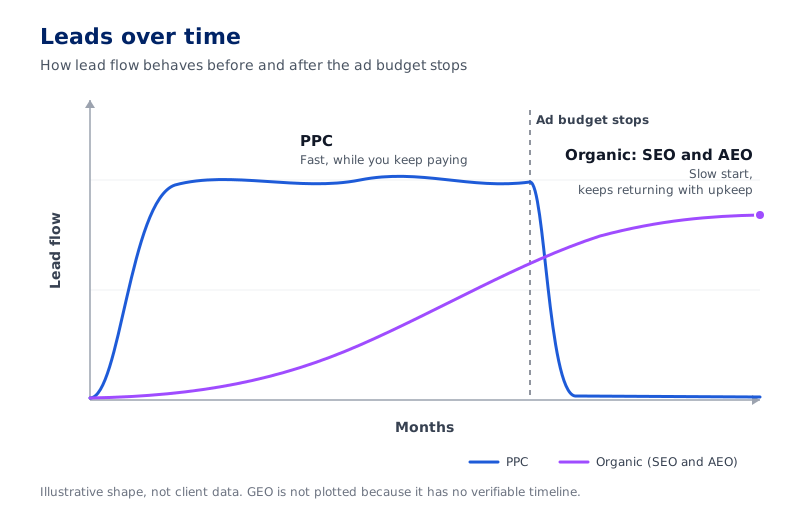
Paid leads stop when the budget stops. Organic work from SEO and AEO starts slowly, then levels off and keeps returning leads as long as it gets upkeep. GEO is left off because no one can verify its timeline.
PPC is the fastest of the four. Paid search can put you in front of buyers this week, and it stops when the budget stops. An account still needs real lead data before it learns which searches pay. Local Services Ads also depend on your reviews and how quickly you respond to leads.
SEO takes longer, and Google says so. Its starter guide notes that some changes might take effect in a few hours, while others could take several months. Google also says no one can guarantee a #1 ranking on Google. The order of results is fairly predictable, with technical fixes showing first, on-page changes next, and new content clusters moving slowest but lasting longest.
AEO moves on the same clock as SEO, because Google's answers draw from the same index. Google says a page must be indexed and eligible to be shown in Google Search with a snippet to appear as a supporting link in AI Overviews or AI Mode. Nobody can quote a reliable fixed timeline for it. Low-competition local questions tend to move before broad category questions do.
GEO is the hardest to time. No AI assistant publishes an impressions report for a local business, and the same question can return different businesses to different people on different days. Anyone who promises a date for a ChatGPT mention is promising something no one controls. The work behind GEO also improves your local search presence, so the effort still pays off in search while you wait.
Key Takeaway: If you need jobs this month, only PPC moves that fast, while SEO and AEO build over months and GEO has no timeline anyone can verify.
How AI Search Changed the Decision
People click less often when Google shows an AI summary. A Pew Research Center study tracked the browsing of 900 U.S. adults in March 2025. Users who saw an AI summary clicked a traditional search result in 8% of visits, compared with 15% for users who did not see one. About 18% of the Google searches in that study produced an AI summary.
Fewer clicks do not remove the need for SEO. Google says the best practices for SEO continue to be relevant because its generative AI features are rooted in its core Search ranking and quality systems. Google's AI answers draw their supporting links from the same indexed pages that compete for rankings. What changes is measurement, since some searches end without a click, so impressions and cited mentions now count alongside traffic.
For a home service owner, the practical shift is smaller than the headlines suggest. A clear page that answers a homeowner's question well now has two chances to be seen, once as a ranking and once as a source inside an answer. Our post on whether SEO is dead covers what changed and what held.
Key Takeaway: People click less when an AI answer appears, but those answers are built on the same index SEO works on, so the fundamentals still decide who gets quoted.
How to Decide Where to Start
The right starting point depends on your situation more than on which term is trending. Find the line below that sounds most like your business right now.
- You need booked jobs this month. Start with paid search, and add Local Services Ads if you qualify and your reviews support it. Build organic work underneath so you are not renting every lead forever.
- Your lead flow is steady, but cost per lead climbs every year. Put more weight on SEO. Organic work takes months to move and keeps returning after it does, which is where the margin is.
- You already rank for your main services. Move to AEO and tighten those pages. Put the direct answer near the top and the details only your team knows below it.
- Your Business Profile, reviews or listings are messy. Fix the public record first. The same cleanup helps map-pack rankings and gives AI assistants accurate facts to read.
- Someone is pitching you a separate AI package. Ask what it does that SEO and local work do not. If it depends on a special file or markup, Google's own guidance says you do not need one to appear in Google Search, including its AI features.
Whatever you choose, measure it against booked jobs rather than clicks or rankings alone. That takes tracking that ties each call and form back to its source, which our guide to marketing attribution for home service businesses explains. For the map-pack side of the decision, the local SEO playbook for home service businesses is the next read. Over time, AEO and GEO should ride on the same pages, reviews and listings that your SEO work builds.
Key Takeaway: Pick your starting point by runway, using paid when you need jobs now, organic when you need margin, and clean listings before anyone sells you an AI shortcut.
Frequently Asked Questions
What is the difference between SEO, AEO and GEO?
SEO vs PPC: which should I start with?
Is AEO different from SEO?
How long does SEO take to work?
Do I need a special file or markup to show up in AI answers?
Do people click less when Google shows an AI summary?
What does GEO cost?

Joel Keith
CEO and Partner at ASP
Joel Keith is CEO and a partner at ASP, a growth-systems marketing agency for home service operators. He is a marketing operator who has spent years inside home service companies, building and refining the systems ASP now runs for clients. ASP is a Housecall Pro Affiliate.
Ready to Put This Into Action?
ASP can help you implement these strategies and build a marketing system that drives measurable growth.