
What will change in SEO and AEO in 2027 for a home service business? We expect homeowners to read an AI answer before they see your listing. We also expect the companies that come out ahead to show up in more places, own their accounts and measure calls and booked jobs instead of clicks. AEO, short for answer engine optimization, is the work of helping your business show up accurately in AI answers from tools like Google's AI Mode and ChatGPT. At ASP, a done-for-you marketing agency for HVAC, plumbing, roofing, remodeling and other home service companies, we are making seven predictions for 2027.
For each prediction, we cover what we expect, the evidence behind it and what an owner should do now. These are forecasts, not guarantees, and we point out where the published evidence stops and our own judgment starts. If you are new to the terms, our comparison of SEO, PPC, AEO and GEO explains how they fit together. The table below sums up all seven.
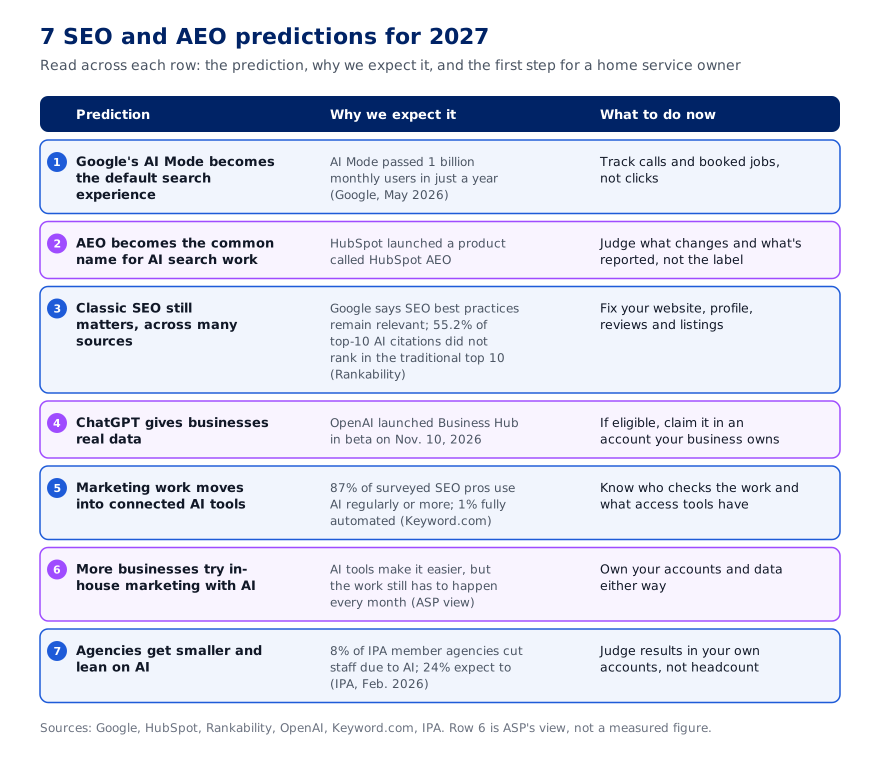
Read across each row: the prediction, why we expect it, and the first step for a home service owner.
Will Google's AI Mode Become the Default Search Experience?
We predict that in 2027, Google's AI Mode becomes the default search experience and the first thing most people see when they search. The classic list of results will still be there, but we expect it to sit underneath the AI answer. For a homeowner searching "ac repair near me," that means reading an AI-written summary before reaching any company's listing.
The usage numbers point that way. At Google I/O on May 19, 2026, Google said "AI Overviews now has over 2.5 billion monthly active users." It also said AI Mode, "in just a year," had "already surpassed 1 billion monthly active users." Google's Search announcement from the same day says people can ask a follow-up question right from an AI Overview and move into a conversation in AI Mode. It adds that this experience is "live today across desktop and mobile, worldwide."
Google's search business is also still growing. Alphabet's third-quarter 2026 earnings release reports Google Search & other revenue of $63.35 billion, up from $56.567 billion a year earlier. Google said in that release that "Our AI investments are driving overall Search query growth, including commercial queries," and that "our year-over-year query growth rate is the highest it's been in the last five years." In our view, a search business that large is one reason Google will keep the classic results underneath the AI answer instead of removing them.
For an owner, the change is about where a homeowner forms a first impression. If the AI answer names a few companies and sums up what people say about them, we expect some homeowners to call without visiting any website. That makes clicks a weaker measure of search work than calls and booked jobs. Google's own page on AI features says that when people click from results pages with AI Overviews, "these clicks are higher quality." That is another reason to count outcomes over visits. Our guide to marketing attribution for home service businesses explains how to tie calls and jobs to their source. This month, search your main service and town, read the AI answer and write down which companies and sources it names.
Key Takeaway: Expect homeowners to read Google's AI answer before your listing in 2027, so track calls and booked jobs by source instead of judging search work on clicks.
AEO Will Become the Name Everyone Uses for AI Search Work
We predict that "AEO" becomes the name most people use for AI search work in 2027, and that more vendors will sell it as its own service. Owners will see it on proposals, in software and in job titles.
HubSpot, a large software company, is already using the term. HubSpot has launched HubSpot AEO. Its announcement page, updated April 14, 2026, describes it as a solution that "shows marketers how their business appears across answer engines like ChatGPT, Gemini, and Perplexity." We expect agencies, freelancers and other software makers to adopt the same label over the next year.
Search interest gives a mixed picture. Rankability's keyword study tracked 3,751 AI and search-related keywords across 48 months of Google Keyword Planner data. In that panel, SEO-related search demand fell 30% from its 2025 peak. AEO and GEO demand grew through 2024 and 2025 before leveling off in early 2026, and over the measured period, GEO drew roughly 2.2 times as much search demand as AEO. So this prediction rests on how vendors are naming their products, not on what people type into Google.
For an owner, the work behind the label is what counts. Google's page on AI features says "There are no additional requirements to appear in AI Overviews or AI Mode, nor other special optimizations necessary." Google's guide to optimizing for generative AI search adds, "No third-party tool has access to our internal ranking or AI systems." When someone sells you AEO, ask what they will change on your website, Google Business Profile and listings, and what they will report to you each month.
Key Takeaway: AEO will show up on more proposals in 2027, so judge any AEO offer by the specific changes it makes and the reports you receive, not by the name.
Why Classic SEO Still Matters When AI Pulls From Many Sources
We predict that classic SEO stays a foundation of AI search in 2027, but that winning will mean showing up across many sources at once. For a home service company, we expect those sources to include your website, your Google Business Profile, your reviews, YouTube, directories and other third-party pages.
Google's guidance supports the first half of that prediction. Its page on AI features says "The best practices for SEO remain relevant for AI features in Google Search." It also says that to appear as a supporting link, "a page must be indexed and eligible to be shown in Google Search with a snippet." Google's AI optimization guide says "Our AI systems take a look at a variety of sources," and that its generative AI features "can show what's being said about products and services across the web." The same guide says Business Profiles "can help your products and services to be visible in both AI responses and other Google Search results."
Rankability's citation study shows how rankings and citations relate. In a sample of 1,645 AI citations and 916 traditional search results, pages in positions 1 to 3 were included in AI citations 98.9% of the time (92 of 93). In the same study, 55.2% of the top-10 AI citations did not rank in the traditional top 10 for the same query (171 of 310).
For a home service company, coverage starts with service pages and city pages that rank for your trade and towns (see our home service SEO page). Then come a complete Google Business Profile, steady reviews, accurate directory listings and videos that answer the questions homeowners ask. Our post on your Google Business Profile as an AI data source covers the profile side, and Is SEO Dead? What AI Search Changed covers how search itself has shifted. Start with your top service and town. List every place a homeowner or an AI tool could find you, and fix anything that is missing, outdated or inconsistent.
Key Takeaway: Classic SEO still helps get you into AI answers, but in 2027 the companies that show up most will have accurate information across their website, profile, reviews, videos and directories.
Should You Claim Your Business in ChatGPT Now?
Yes, and we would do it now. We predict ChatGPT becomes a real source of business data in 2027. We expect home service companies that can claim their listing early to benefit, because they can keep their information current and start collecting data as soon as there is enough activity to meet OpenAI's thresholds.
On November 10, 2026, OpenAI introduced Businesses in ChatGPT in beta, "giving businesses a new way to connect with the 1.2 billion people who use ChatGPT each week." Through Business Hub, OpenAI says, "businesses can claim their business, manage their information, and see insights on how people engage with them on ChatGPT." Once verified, a business can update key details. The insights include "the number of mentions and website clicks a business receives," plus discovery topics, which OpenAI describes as "common themes across conversations where their website is cited."
There are limits to know about. OpenAI says, "We don't share users' conversations or Business Agent chats with businesses." It also says insights "are only available when there are enough conversations or interactions to meet certain thresholds," so we expect many smaller local companies to see little data at first. OpenAI is starting Business Agents, its tool for answering customer questions inside ChatGPT, with "eligible ecommerce and online service businesses in the U.S." For most home service companies, that means the first step is the listing and its insights. OpenAI says "Any eligible business located where ChatGPT is available can claim their business in ChatGPT through Business Hub," so check your eligibility there.
Claim the listing in an account your business owns, not in an employee's personal account or a login your agency controls. If that person or vendor leaves, the listing should stay with your company. Our post on who owns your marketing data lists the questions to ask about every account, and the same thinking applies here.
We also predict that OpenAI will share more about what people ask in 2027, beyond mention and click counts. OpenAI has not promised this. It has said, "Over time, we plan to expand Businesses in ChatGPT and Business Agents to more markets and business categories, and build tools for organizations with more complex needs." We expect deeper reporting on topics and questions to be part of that expansion.
Key Takeaway: If your business is eligible, claim it in ChatGPT's Business Hub now, in an account your business owns, and treat its mention and click data as an early signal instead of a full picture.
Marketing Work Is Moving Into Connected AI Tools
We predict that more marketing work in 2027 will run through AI agents, which are AI assistants connected directly to tools and accounts so they can pull data and make changes. Instead of a person logging in to five dashboards, an agent will pull the reports, draft the changes and, in some setups, make them.
One 2026 survey of SEO professionals found that regular AI use is common among them, while full automation is rare. Keyword.com's 2026 report on AI in SEO analyzed 97 usable responses from SEO agencies, in-house SEO teams, freelancers, consultants and SEO-adjacent platform teams. It found that "87% of respondents said they use AI regularly, across core workflows, or as a central part of how they deliver SEO work." Only 1% described their work as fully automated, and 99% "described a process that still involves human assistance, review, or task-by-task judgment."
For an owner, two questions follow. The first is who checks the work before it goes live on your website, Google Business Profile or ad account. The second is what access these tools have. An agent connected to your Business Profile or Google Ads account can change what is in it. That access should come from accounts you own, be limited to what the work needs and be easy for you to remove.
Ask any vendor which tools touch your accounts and who reviews what those tools produce. Also ask how you would shut off their access if you ended the relationship. Our checklist on what to secure before you leave your marketing company walks through the accounts to check.
Key Takeaway: AI tools will do more marketing work in 2027, so know who reviews their output and make sure any access they have runs through accounts you own and can revoke.
Can a Home Service Business Bring Marketing In-House With AI?
Some can, and we predict more will try in 2027. In our view, AI tools make it easier for an office manager or an owner to draft posts, respond to reviews and build simple reports. Some companies will make that work.
We also predict that many will find they still need someone doing the work every month. In our view, the tools are not the hardest part of the job. The hard part is knowing which work matters for a home service company and doing it consistently while the phones are ringing and the trucks are out. Even among search professionals, Keyword.com found that when AI is used for work, "44% of respondents said that humans review AI-generated work." Nearly all of its respondents described a process that still involves human assistance, review or judgment. Our guide to adopting AI in a home service business covers where AI tools save time in day-to-day work.
Whichever way you go, we expect the owners who come out ahead to be the ones who own their accounts and data. If your website, Google Business Profile, ad accounts and call tracking are in your name, you can change who does the work without starting over. If they sit in someone else's name, every change of vendor or employee puts them at risk.
ASP runs marketing as a done-for-you monthly service. You own every asset we build and all your data. Our page on what you own when ASP runs your marketing lists what stays in your name.
Key Takeaway: AI makes in-house marketing more realistic, but the work still has to happen every month, and the companies that come out ahead own their accounts and data either way.
Marketing Agencies Will Get Smaller and Lean on AI
We predict that more marketing agencies will run with smaller teams in 2027 and lean on AI for production work. As a result, headcount will tell an owner less about an agency than it used to.
Early survey data points this way. The IPA Agency Census, published February 11, 2026, covers IPA member agencies. It found that "8% of agencies reduced their workforce in the past 12 months as a direct result of AI," and that "24% expect to do so in the next 12 months." Those figures cover IPA member agencies, not every agency, and the 24% is an expectation, not a completed change.
For an owner, size is a weak way to judge a marketing company. Judge it on four things instead: results you can see in your own accounts, who you talk to each month, who reviews the work before it goes live and what you keep if you leave. A large team does not guarantee attention to your account, and a small team is not a warning sign by itself. Our post on the difference between a marketing vendor and a marketing partner covers more questions to ask before you sign.
Key Takeaway: Agency headcount will mean less in 2027, so judge any marketing company by results in your own accounts, the people you deal with, who reviews the work and what you keep if you leave.
What Should a Home Service Owner Do First?
If you only have time for a few steps before 2027, start with these:
- Search your main service and town. Read Google's AI answer and write down which companies and sources it names.
- Track calls and booked jobs by source. Judge search work on the jobs it produces, not on clicks.
- Claim your business in ChatGPT if it is eligible. Use Business Hub, and claim it in an account your business owns.
- Fix the sources AI tools read. Make your website, Google Business Profile, reviews and directory listings accurate and consistent.
- Check who has access. List every tool and vendor with a login to your accounts, and confirm each account is in your name.
None of this comes with a guarantee. Google's AI optimization guide says "Indexing and serving aren't guaranteed," and no one outside these companies controls what an AI tool says. What a home service company can control is whether the information about it is accurate in the places AI tools look, and whether the accounts behind that information are its own. If you want ASP to run that work for you every month, book a strategy call.
Frequently Asked Questions
What is AEO?
Will Google's AI Mode replace regular search results?
Does SEO still matter for AI search?
What is Business Hub in ChatGPT?
Who should own my ChatGPT business listing?
Should I measure AI search by clicks or by calls?
Can ASP guarantee my business will show up in AI answers?
Is ASP a training program or a done-with-you service?

Joel Keith
CEO and Partner at ASP
Joel Keith is CEO and a partner at ASP, a growth-systems marketing agency for home service operators. He is a marketing operator who has spent years inside home service companies, building and refining the systems ASP now runs for clients. ASP is a Housecall Pro Affiliate.
Ready to Put This Into Action?
ASP can help you implement these strategies and build a marketing system that drives measurable growth.