Google's November 2026 core update started on November 10, and as of November 16 it was still rolling out. My short answer for home service owners is simple. Don't make big structural changes to your website until it finishes, keep your normal work going, and wait until December to judge what it did. Google says the rollout may take up to two weeks, and it had not posted an end date when we checked.
ASP is a growth-systems marketing agency for home service operators. This post covers what Google has confirmed, what nobody knows yet, what I'm holding off on, and which weeks we'll compare once it's done. Everything here follows the sources as we checked them on November 16, 2026.
What Google Has Confirmed About the November 2026 Core Update
Google posted the update on its Search Status Dashboard with a start time of November 10, 2026, at 10:06 a.m. Pacific time. The entry says Google "released the November 2026 core update, which applies globally and to all languages." It also says "the rollout may take up to 2 weeks to complete."
Google Search Central described it as "a regular update designed to better surface relevant, satisfying content for searchers from all types of sites." According to launch coverage from a search industry news site, Google published no Search Central blog post and no new guidance with it. So Google has not said what this update targets.
This is the third core update of 2026. Google's dashboard history shows the March update ran about 12 days and the May update ran about 12 days.
When it could finish
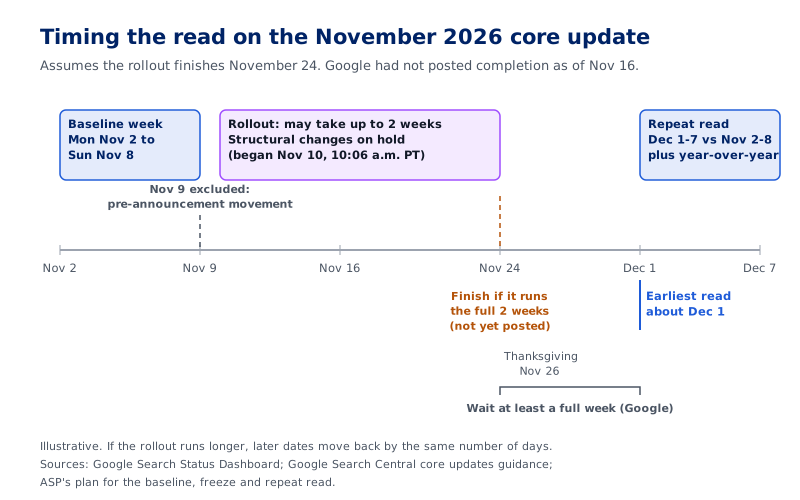
If the update uses the full two weeks, it ends on November 24. A paid-search news site pointed out that this lands "two days before Thanksgiving and three before Black Friday." Some core updates run longer. A search news site that logs every core update lists the December 2025 update at 18 days and puts the median rollout length since 2019 at 14 days.
Here is where things stood when we checked:
| Item | Status when we checked |
|---|---|
| Start | Confirmed by Google: November 10, 2026, 10:06 a.m. PT |
| Scope | Confirmed by Google: global, all languages |
| Rollout length | Confirmed by Google: "may take up to 2 weeks" |
| End date | Not posted as of November 16 |
| What it targets | Not stated by Google; no new guidance |
| How big it is | No size figure published as of November 12 |
Key Takeaway: Google has confirmed the start date, the scope and a window of up to two weeks. It has not said what the update targets, and as of November 16 it had not posted that the rollout was complete.
Why the "Panda" Label Is Speculation
Some people in the industry have called this a "Panda-level" update. That label is industry speculation that traces back to a forecast published in October, and it is not how Google described the update. As of November 12, nothing measured justified it. On November 11, one analyst who tracks core updates said, "We are less than one day into the update so there is little to report on that front."
Panda was a Google update from 2011. In its February 2011 announcement, Google said that change "noticeably impacts 11.8% of our queries." As of November 12, no comparable figure had been published for the November 2026 update.
I'm not using the word Panda with anyone right now, and I'd suggest you don't either. A label like that makes people expect damage before there is any data. That's usually when owners start making rushed changes to a website that may have been fine.
What I'm Not Changing Until the Rollout Ends
At ASP, we're freezing structural changes on websites until Google posts that the update is complete. That covers four kinds of work:
- URL changes
- Mass deletes of pages or posts
- Template rewrites
- Redirect projects
Google's own guidance on core updates points the same way. Google's page on core updates says there's no need to take drastic action for small drops. It tells site owners to "avoid doing 'quick fix' changes," and it says "deleting content is a last resort, and only to be considered if you think the content can't be salvaged."
From where I sit, the bigger problem with a mid-rollout change is measurement. If you move URLs or rewrite templates while Google is still re-ranking pages, you can't tell later whether the update or your change moved your numbers. It's tough to sit on your hands when rankings move. But a clean comparison in December is worth more than a guess in November.
Key Takeaway: Hold URL changes, mass deletes, template rewrites and redirect projects until Google posts completion. That way, December's numbers show what the update did and not what you changed.
The Normal Work That Keeps Going
Freezing structure doesn't mean freezing the website. At ASP, normal publishing and bug fixes keep going through the rollout. A broken contact form is still worth fixing this week, and a fix like that doesn't touch your site's structure.
New pages should still meet the bar that earlier updates seem to have rewarded. After the March 2026 update, a marketing firm that works with local service companies wrote that when a site had 15 or 20 location pages that looked roughly the same, with just the city name swapped in, those pages likely lost rankings. These are agency reports, not controlled data. Another firm's write-up on service-area pages offers a simple test: a service-area page holds up only when swapping in another city's name would make it false.
So if you publish a city page this month, write things on it that are only true for that city. That means the areas you serve there, the work your crews do there and the details a local customer would recognize. I'd still wait until December to rebuild a whole set of city pages, because a rebuild across many pages is a template rewrite.
Our post on real SEO vs. fake SEO explains where the line sits between real work and shortcuts. The bigger picture lives in our local SEO playbook for home service businesses.
When Should You Read the Results?
At ASP, we're locking Monday, November 2 through Sunday, November 8 as the baseline week, which is the week we compare against. It skips November 9, which had some ranking movement before Google announced the update. A clean baseline matters because every comparison later depends on it.
Google's guidance says, "We recommend waiting at least a full week after a core update completes before analyzing your site in Search Console." If the update finishes November 24, the earliest real read is about Tuesday, December 1.
Thanksgiving complicates the first read
Thanksgiving falls inside that first clean week. Holiday weeks and seasonal heating demand can move your numbers on their own, apart from anything Google does. So we'll repeat the comparison for December 1 through 7 against November 2 through 8, and add a year-over-year look at the same weeks.
If the rollout runs longer than two weeks, every date after the rollout moves back by the same number of days. The November 2 through 8 baseline stays the same. An 18-day rollout like December 2025's would end around November 28.
Judge it by calls and booked jobs
Rankings and clicks tell you what Google did. Booked jobs tell you what it meant for your business. When we read December's numbers, we'll put Search Console clicks next to calls and form leads, and we'll judge each channel by cost per booked job. Our guide to marketing attribution for home service businesses explains how to tie each booked job back to the channel that produced it.
Key Takeaway: Compare against November 2 through 8 and start reading about a week after Google posts completion. Then repeat the read for December 1 through 7 with a year-over-year check, because Thanksgiving lands in the first clean week.
Frequently Asked Questions
Will the core update hurt my Google Business Profile rankings?
As of November 12, no data on this update's effect on local rankings had been published. In past core updates, map pack rankings have sometimes held while website traffic fell. One write-up on how core updates affect local businesses described businesses losing more than 90 percent of their organic traffic while their Business Profile kept top map pack positions. That is a past pattern from client audits, not data on the November 2026 update. Track your Business Profile calls separately from your website clicks so you can tell the two apart.
Should I delete old pages if my traffic drops?
Not during the rollout. Google's guidance on core updates calls deleting content a last resort, and it says to consider it only if you think the content can't be salvaged. Google also says to wait at least a full week after an update completes before you analyze your site in Search Console. If a page lost traffic, look at whether it can be improved before you think about removing it.
Does Google penalize content written with AI?
Google's documented red flags are about scale and intent. Its helpful content guidance asks whether you are using extensive automation to produce content on many topics, whether you are producing lots of content in hopes that some of it might perform well, and whether you are changing page dates to make them seem fresh when the content has not substantially changed. Google's target is low-value content made in bulk to manipulate rankings, not AI authorship as such. The same page says using generative AI to produce large amounts of text without manual oversight or curation shows little to no effort, and that fake author profiles, such as AI-generated headshots or made-up names, are deceptive.
How long does recovery take if my site drops?
Google says it could take several months for its systems to learn and confirm that a site has improved, and that there is no guarantee changes you make will have a noticeable impact in search results. Google also says you don't necessarily have to wait for the next major core update to see the effect of your improvements, because it continually makes smaller updates. That is why we read the results first and make changes after we know what moved.
What kinds of sites did well in the last core update?
For the March 2026 update, one SEO agency's analysis of 2,076 domains found that the top of the winner list was almost entirely the company that owns the thing, while the top of the loser list was almost entirely the platform people use to talk about the thing. In travel, it suggested Google may be preferring sites where people can take a direct action, such as booking. That analysis covers March, not November, and no home services dataset has confirmed the pattern. If November follows the same direction, a real company's own site could gain ground on directories, but that is a possibility, not a finding.
How can I tell if the update caused my drop or something else did?
Look at two places separately. Organic clicks in Google Search Console are where a core update's effect shows. Calls and direction requests in Business Profile Insights, along with your call tracking, are where changes to Google's local results show. If your organic clicks hold steady while your Business Profile calls fall, that points to a layout change on Google's results page, not the core update. Those are different problems with different fixes.
Hold Steady Through November, Then Look in December
Google confirmed the November 2026 core update on November 10, and as of November 16 the rollout was still in progress with no end date posted. As of November 12, no one had published a measured size for it, Google has not said what it targets, and the "Panda" label is speculation.
So here's the plan at ASP. We're holding structural changes until Google posts completion, and we're keeping normal publishing and bug fixes going. We've locked November 2 through 8 as the baseline. The first read comes about a week after the update finishes, which is about December 1 if it ends November 24, followed by a second read for December 1 through 7 with a year-over-year check. When we read those numbers, we'll judge them by calls and booked jobs, not rankings alone.
If you want help reading December's numbers against your booked jobs, talk with our team.
Frequently Asked Questions
Will the core update hurt my Google Business Profile rankings?
Should I delete old pages if my traffic drops?
Does Google penalize content written with AI?
How long does recovery take if my site drops?
What kinds of sites did well in the last core update?
How can I tell if the update caused my drop or something else did?

Joel Keith
CEO and Partner at ASP
Joel Keith is CEO and a partner at ASP, a growth-systems marketing agency for home service operators. He is a marketing operator who has spent years inside home service companies, building and refining the systems ASP now runs for clients. ASP is a Housecall Pro Affiliate.
Ready to Put This Into Action?
ASP can help you implement these strategies and build a marketing system that drives measurable growth.