HVAC SEO is the work of getting a heating and cooling company found when a homeowner searches for help. That covers Google's map pack, the regular results below it, and the AI answers Google shows above both on some searches. What ranks in 2026 is less mysterious than most sales pitches make it sound. Google's own help page explains local results through relevance, distance and prominence, and the websites that win are the ones that answer a homeowner's question better than anyone else in the market.
Reviews, the seasonal calendar and the gap between a planned install and a no-heat call at night fill in the rest of the picture. This guide covers each piece for an established HVAC company without an in-house marketing person. It sticks to what Google and other primary sources have published, plus how we approach home service SEO at ASP for trades that run on the weather.
How Google Ranks HVAC Companies in the Map Pack
When someone searches "furnace repair near me," Google often shows a map and a short list of Business Profiles near the top of the results. Google's help page on local ranking explains how that list gets picked. Relevance is "how well a Business Profile matches what someone is searching for." Distance is how far each business is from the person searching, and prominence is how well-known a business is, based partly on how many websites link to you and how many reviews you have.
Distance is the one factor you cannot change, so the work goes into relevance and prominence. Google says businesses with complete and accurate info are more likely to show up in local search results, and it states that there is no way to request or pay for a better local ranking. For an HVAC company, complete means the right primary category, every service you want calls for, accurate hours, a real service area and photos of your own trucks and crews. Google also asks businesses to use as few categories as possible to describe the core business, so skip the long list of loosely related categories.
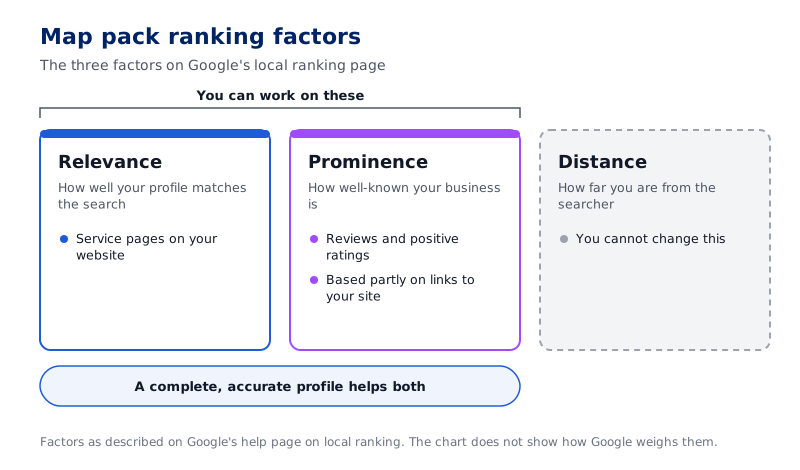
Two of the three factors respond to work on your profile, your website and your reviews.
Three profile rules are worth checking before anything else. Google's Business Profile guidelines say that including unnecessary information in your business name isn't permitted and could get the profile suspended, which rules out names like "Smith Heating & Cooling Best AC Repair Dallas." Service-area businesses should hide their address from customers, and the service area shouldn't reach farther than about two hours of driving from where the business is based. Our local SEO playbook for home service businesses goes deeper on the profile, and our comparison of Google Business Profile vs. your website covers which one to fix first.
Key Takeaway: You cannot move your shop closer to every customer, but you can make your profile complete, accurate and inside Google's rules, which covers the two ranking factors you control.
Service Pages That Match How Homeowners Search
Relevance also comes from your website. A homeowner searching "heat pump installation" and one searching "AC blowing warm air" want different things, and a single "Heating and Cooling Services" page cannot answer both well. We decide which services get their own page by demand first, then by what a booked job in that service is worth, then by how strong the pages already ranking are. A service with steady searches and good margin earns a full page, while a service nobody searches for by name can live inside a broader page.
What goes on the page decides whether it ranks. Google's guide to helpful, people-first content asks whether content shows "first-hand expertise and a depth of knowledge," such as expertise that comes from having used a product or service. For an HVAC company, that means the details only a working contractor knows. Examples include how your techs tell a simple repair from a failing system, when a repair stops making sense on older equipment, what drives the price of an install in your market, and what gets checked first on a service call.
Those details come from you or a senior tech, which is why we interview for them instead of writing from what other sites already say. Google also warns against producing lots of content on many different topics in the hope that some of it performs, and against using extensive automation to produce content on many topics. Google's spam policies list "creating substantially similar pages that are closer to search results than a clearly defined, browseable hierarchy" as an example of doorway abuse. That is a good reason to skip the shortcut of copying one city page thirty times with the town name swapped. A city page earns its place only when it says something true about that area, such as the age of the homes you work on there or the permit process in that county.
The technical side has to hold up too. Pages need to be indexed, load quickly on a phone and sit behind clean redirects, because a page Google cannot read cannot rank. Our SEO service page lays out how we sequence that work by what each problem costs.
Key Takeaway: Build a real page for each service that earns you money, and fill it with the specifics a homeowner would only hear from someone who does the work.
How Reviews Help an HVAC Company Rank
Google's local ranking page says directly that more reviews and positive ratings can help your business's local ranking. Reviews also do the selling once a homeowner is looking at the list. We look at review volume and recency together, because a pile of reviews from years ago describes a business that may have changed since.
The practical move is to make the request part of closing every job. Google's review guidance suggests asking customers to visit a Google link or scan a QR code, which fits on an invoice, a leave-behind card or a follow-up text. The same page tells businesses to reply to reviews. A calm, specific reply to a bad review shows the next reader how your company handles a problem.
The rules on incentives are strict. Google says offering free or discounted goods or services in exchange for reviews is strictly prohibited. The Federal Trade Commission's final rule on fake reviews, announced in August 2024, bans fake reviews, including AI-generated ones, and bans incentives conditioned on a review expressing a particular sentiment. A "$25 off for a five-star review" card breaks both sets of rules.
Key Takeaway: Ask every customer for a review as part of the job, reply to what comes in, and never pay or discount for a review.
Seasonal HVAC Content: Publish a Season Early
HVAC demand follows the weather, and so do the questions homeowners bring to Google. ENERGY STAR's heating and cooling maintenance checklist tells homeowners that contractors get busy once summer and winter come, so it's best to check the cooling system in the spring and the heating system in the fall. The same calendar tells you when your content has to be ready.
SEO work takes months to show results, and there is no reliable fixed timeline for it. A cooling page published during the first heat wave is late for that summer. Plan cooling pages and AC maintenance content through the winter and heating content through the summer, so the pages are indexed before demand arrives. When a season comes back around, update last year's seasonal pages with fresh details and dates instead of starting new pages that compete with the old ones.
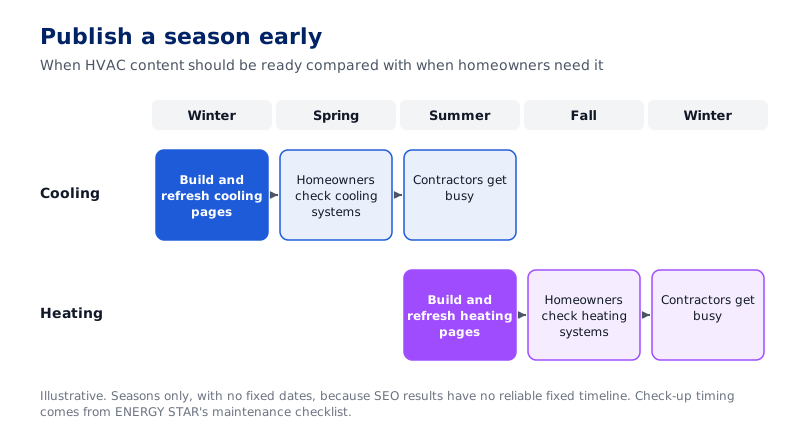
Each content block sits one season ahead of the check-ups and busy months it serves.
Your profile should follow the season too. Google's guidelines let a business use its current seasonal hours as its regular hours where that applies, so update them when your schedule changes. If a soft year has you rethinking spend, our piece on what soft HVAC demand means for your marketing budget covers the budget side of that decision.
Key Takeaway: Publish and refresh seasonal pages a season early, because the page a homeowner finds in July had to be built in the spring or before.
Emergency Searches Work Differently
In our view, a homeowner with no heat on a January night rarely reads blog posts or compares five companies' service pages. They are more likely to look at the map, check the rating and call. For those searches, the basics have to be right: the correct phone number, accurate hours, the right category and a profile with recent reviews.
Accuracy counts most here. If your profile shows round-the-clock service and nobody answers at 2 a.m., the homeowner calls the next company on the list. Google asks businesses to provide their regular customer-facing hours, so list after-hours service only if a person or a real answering process picks up the phone. The same logic applies to your name, address and phone number across every directory, which our guide to NAP consistency explains.
On the website, an emergency page should make the phone number easy to tap and say clearly which problems you treat as urgent. Avoid promising a response time on the page unless you can meet it every time, in every season.
Key Takeaway: Get the phone number, hours and category on your profile right before any content work.
Do AI Overviews Change HVAC SEO?
On some searches, Google shows an AI Overview above the regular results, and AI Mode is a separate conversational search experience. Google's documentation on AI features in Search says the best practices for SEO remain relevant for these features, and that there are no additional requirements to appear in AI Overviews or AI Mode. To be shown as a supporting link, a page has to be indexed and eligible to appear in Search with a snippet. Google also lists keeping your Business Profile information up to date among the practices that still apply.
For an HVAC company, the same work covers both: a complete profile, real reviews, service pages built from first-hand knowledge and a site Google can crawl. Nobody can promise you a spot in an AI answer, and you should be wary of anyone who sells a special file or markup as the way in. Our page on answer engine optimization explains how we treat Google's answer features and what can and cannot be measured there.
Key Takeaway: Google says its AI features run on normal SEO best practices, so an HVAC company does not need a separate AI plan to be eligible.
Where an HVAC Company Should Start
The order of work for an HVAC company is fairly predictable. Start by fixing anything that stops Google from reading your site. Then turn to the Business Profile: category, services, hours, service area and a name that follows Google's rules. Put the review request into how every job closes. Then build or rebuild the pages for your highest-value services, and plan seasonal content one season ahead. Deeper content work comes after those pieces are in place, because a strong article cannot make up for a wrong phone number or a thin service page.
Frequently Asked Questions
What is HVAC SEO?
How does Google decide which HVAC companies show in the map pack?
Can I pay Google to rank higher in the map pack?
Can I add keywords or my city to my Google Business Profile name?
Does every HVAC service need its own page?
When should an HVAC company publish seasonal content?
Can I give customers a discount for leaving a Google review?
Do AI Overviews need a separate HVAC SEO strategy?

Joel Keith
CEO and Partner at ASP
Joel Keith is CEO and a partner at ASP, a growth-systems marketing agency for home service operators. He is a marketing operator who has spent years inside home service companies, building and refining the systems ASP now runs for clients. ASP is a Housecall Pro Affiliate.
Ready to Put This Into Action?
ASP can help you implement these strategies and build a marketing system that drives measurable growth.