
Yes, there are proven strategies for ranking in AI search, but they are more basic than most sales pitches suggest. Google, OpenAI, Perplexity and Microsoft have each published what their AI search features need from a website. Almost all of it is standard SEO: let the crawlers in, get your pages indexed, keep your business information current, and publish useful pages built from real experience. Most other advice on how to rank in AI search is speculation, even when it sounds technical.
Ranking in AI search means getting your business named, quoted or linked inside an AI-generated answer. At ASP we split that work by platform. Answer engine optimization covers Google's AI Overviews and AI Mode, while generative engine optimization covers standalone assistants like ChatGPT and Perplexity. Both rest on the same SEO foundation, and this post separates what the platforms have documented from what nobody has proven yet.
What Has Google Documented About Its AI Features?
Of the four platforms, Google has published the most about its AI search features, and its message is consistent. Its guide to optimizing for generative AI features on Google Search says it directly: "The best practices for SEO continue to be relevant because our generative AI features on Google Search are rooted in our core Search ranking and quality systems." The AI answer is built from pages Google has already crawled, indexed and judged useful.
The entry requirement is also written down. Google's AI features documentation says that to be a supporting link in AI Overviews or AI Mode, a page "must be indexed and eligible to be shown in Google Search with a snippet." The same page says there are no additional requirements and no other special optimizations necessary. A page that is blocked from crawling, left out of the index, or set to hide its snippet cannot be a source.
Google also explains why one page can appear for a question it never targeted. According to that same documentation, both features may use a "query fan-out" technique, running several related searches across subtopics to build one response. A homeowner who asks why their furnace keeps shutting off could set off related searches about filters, flame sensors and repair costs. A heating company with solid pages on each of those topics gives Google more to draw from than one generic furnace repair page does.
Key Takeaway: Google's AI answers come from its normal index, so a page that cannot show up in regular search with a snippet cannot be cited.
What Do ChatGPT, Perplexity and Copilot Say?
The standalone assistants publish far less, but what they do publish is useful. OpenAI's crawler documentation says "OAI-SearchBot is used to surface websites in search results in ChatGPT's search features." OpenAI recommends allowing that crawler in your robots.txt file and allowing requests from its published IP ranges. Perplexity's bot documentation gives the same advice for PerplexityBot, which it says "is designed to surface and link websites in search results on Perplexity."
Microsoft ties its assistant to its existing search engine. A Bing product manager wrote on Microsoft's advertising blog that experiences like Microsoft Copilot are "powered by Bing's search index." For Copilot, that makes Bing's index the foundation to check first.
The platforms do not agree on every detail. Microsoft's post says assistants like Copilot break content into "smaller, structured pieces" and describes schema as code that "helps search engines and AI systems understand your content." Google says neither is required for its own features. None of these companies publish a list of the factors that decide which business gets recommended. OpenAI's and Perplexity's crawler documentation covers access, not ranking.
Key Takeaway: For ChatGPT and Perplexity, the only published requirement is letting their search crawlers read your site, and everything past that is educated guessing.
What Google Says Does Not Help
Google's guide spends a surprising amount of space on tactics it says you can skip. On llms.txt and similar files, the guide says: "You don't need to create new machine readable files, AI text files, markup, or Markdown to appear in Google Search (including its generative AI capabilities), as Google Search itself doesn't use them." It also says "Structured data isn't required for generative AI search, and there's no special schema.org markup you need to add."
The list keeps going. Google says there is no requirement to break your content into tiny pieces for AI, and that "You don't need to write in a specific way just for generative AI search." On planted or paid mentions, the guide says "seeking inauthentic 'mentions' across the web isn't as helpful as it might seem."
This is why ASP does not sell an llms.txt file or schema as a way into AI answers. Schema still has a real job, which is making a page eligible for rich results, and we build it for that reason. We just won't bill it as an AI lever on Google when Google says it isn't required for its AI features. Our post on real SEO versus fake SEO covers the same test from the spam side: a tactic that depends on Google not noticing is a poor place to put your budget.
Key Takeaway: Before paying for an AI file, AI schema or an AI writing style, check it against Google's own list of things it says you do not need.
Where Does the Evidence Run Out?
The research that named the field is the 2023 paper "GEO: Generative Engine Optimization". Its authors tested content changes against a benchmark of queries and reported that GEO "can boost visibility by up to 40% in generative engine responses." The same abstract says "the efficacy of these strategies varies across domains." That finding comes from a research benchmark, and it does not tell you what ChatGPT says when a homeowner asks for a plumber in your town.
Local recommendations are even harder to study. As our GEO page explains, no assistant publishes anything like an impressions report for a local business. The same question can also return different businesses to different people on different days. Nobody outside these companies has a controlled test showing that one profile edit changed an assistant's answer. We walk through what the published studies do and do not show in Does GEO Work? What the Evidence Shows.
Keep that gap in mind when someone promises your business a spot inside ChatGPT or a set number of AI citations. A promise tied to a system that nobody outside the company controls cannot be kept by the person making it. Ask the seller which published source supports each step of the plan, and see how many steps survive the question.
Key Takeaway: Research shows content changes can shift AI visibility on a research benchmark, but no one has shown a reliable method for getting a local business recommended.
Evidence-Backed Ways to Rank in AI Search
Everything below traces back to guidance the platforms themselves have published. None of it is exotic, and most of it also helps your regular search results, which is a good sign the money is well spent.
- Let the right crawlers in. Check your robots.txt file and your hosting firewall for blocks on Googlebot, OAI-SearchBot and PerplexityBot. Since Copilot runs on Bing's index, Bingbot belongs on that list too.
- Confirm your key pages are indexed. Check in Google Search Console that your main service pages are in the index and allowed to show a snippet.
- Keep your Google Business Profile current. Google's guide says Business Profiles can help your products and services be visible in both AI responses and other Google Search results. Keep your name, address and phone number consistent everywhere you are listed.
- Write from the job. Google's guide tells site owners to "Create the content yourself based on what you know about the topic, and consider what in-depth experience you can bring to your content."
- Answer the questions you already get on the phone. A page for each real customer question gives fan-out searches something specific to find.
- Link related pages together. Google's AI features documentation lists internal links among the SEO basics that still apply.
For an HVAC or plumbing company, "write from the job" means the details a competitor cannot copy from another website. That includes what a repair costs in your market, which failures show up each season, and what you tell a homeowner before they ask. Our local SEO playbook for home service businesses covers the profile and listings side in more depth.
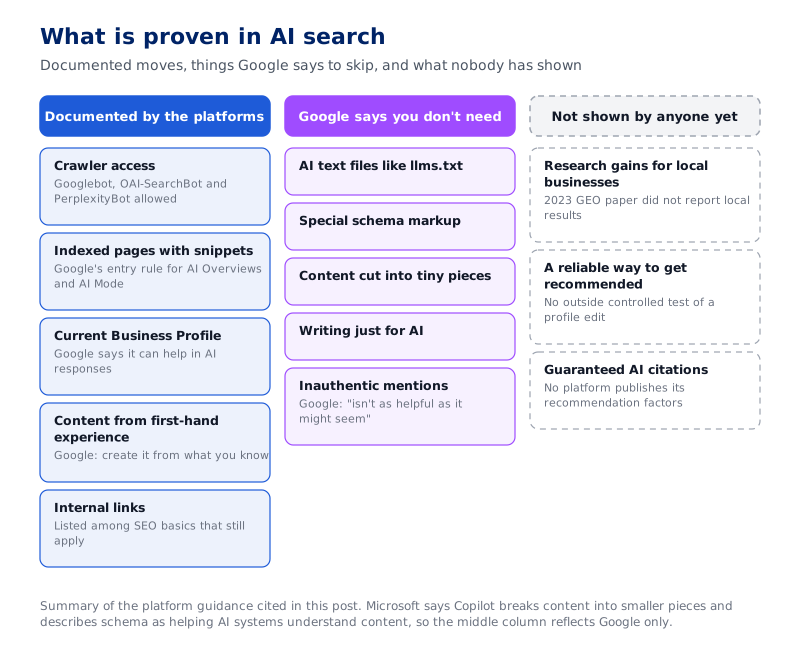
Check where a pitched tactic falls before you pay for it. Only the left column has platform documentation supporting it.
Key Takeaway: The documented moves for AI search are crawl access, indexing, an accurate Business Profile and first-hand content, and each one also helps your regular rankings.
How Do You Measure AI Search Visibility?
Measurement is where many AI search services get vague, so start with the tools the platforms provide. Google Search Console now has a Generative AI performance report covering AI Overviews and AI Mode. Google defines its impressions as "how many times links to your site were shown to a user in a generative AI feature on Google Search." Google says it rolled the report out to all websites worldwide as of August 31, 2026.
Google's optimization guide also warns: "Be wary of third-party tools that promise ranking success or claim to use 'internal' Google metrics." Microsoft's Bing Webmaster Tools has an AI Performance report, announced as a public preview in February 2026, that shows how often your content is cited in generative answers across Microsoft Copilot and AI-generated summaries in Bing. For ChatGPT and Perplexity, there is no comparable report for a local business. The most reliable option there is a repeatable spot-check: a fixed set of homeowner-style questions, asked in the same places on a schedule, with the results written down. After that, tie any change back to calls, leads and booked jobs.
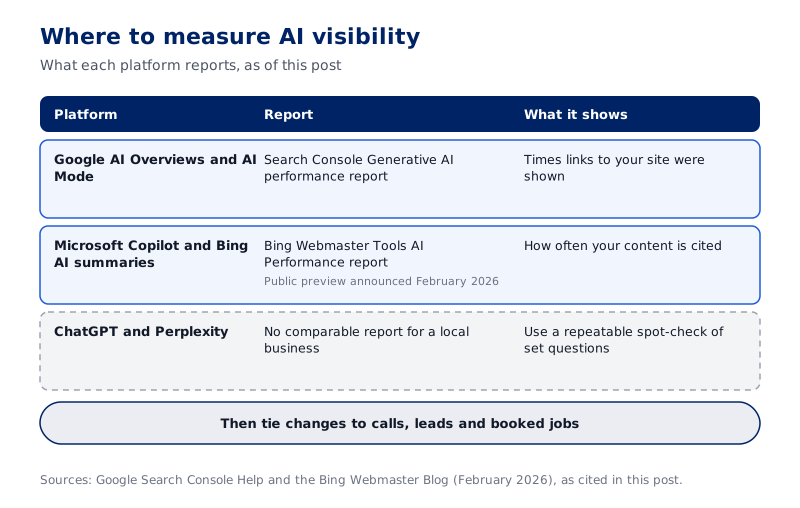
Google and Microsoft offer first-party reports. ChatGPT and Perplexity have no comparable report for a local business, so a written spot-check log is the record.
Key Takeaway: Use Google's own report for AI Overviews and AI Mode, and treat any AI visibility number without a named source with caution.
What This Means for Your Marketing Budget
The proven strategies for AI search are the ones the platforms have written down, and they overlap almost completely with good SEO. Open your site to the crawlers, get your service pages indexed, keep your Business Profile accurate, and publish pages that only someone who has done the work could write. Those steps earn their keep in regular search whether or not an AI answer ever names you.
Everything beyond that is still being tested by researchers and guessed at by vendors. You can spend some time watching it, but spend your budget on the documented work first. When someone pitches an AI search product, ask which published source supports it. If the only source is their own sales deck, you have your answer.
Frequently Asked Questions
Are there proven strategies for ranking in AI search?
Do I need an llms.txt file to show up in Google's AI Overviews?
Does schema markup help my business get cited by AI?
How do I get my website into ChatGPT search results?
Does my Google Business Profile affect AI answers?
Can an agency guarantee my business will be recommended by AI?
How can I tell if my site appears in Google's AI features?
Does the GEO research prove these tactics work for local businesses?

Joel Keith
CEO and Partner at ASP
Joel Keith is CEO and a partner at ASP, a growth-systems marketing agency for home service operators. He is a marketing operator who has spent years inside home service companies, building and refining the systems ASP now runs for clients. ASP is a Housecall Pro Affiliate.
Ready to Put This Into Action?
ASP can help you implement these strategies and build a marketing system that drives measurable growth.