Google wants local content that is made for people first, shows real expertise, and answers the longer, more specific questions homeowners now ask. That's the short answer, and most of it comes from Google itself. At its Home Services Summit, Google shared that search is growing, not shrinking, and that the questions people type and speak keep getting longer.
ASP is a growth-systems marketing agency for home service operators. This post covers what Google says it wants from local content now, how demand differs across HVAC, plumbing, electrical and roofing, and a simple test you can run on your city pages. If you want the groundwork first, start with our guide to local SEO for home service businesses. Everything here reflects the sources as we checked them on November 16, 2026.
Search Is Growing, and the Questions Are Getting Longer
One takeaway from Google's Home Services Summit is that search is growing, not shrinking. Google put the number at more than 5 trillion searches a year, and it said search sessions are longer than ever. For a home service company, that means the people who need you are still searching, and many of them are spending more time doing it.
The bigger change is in how people ask. Google shared at the summit that the fastest-growing group of searches is eight words or longer, and that voice and conversational search are driving it. A homeowner who used to type "furnace repair" might now ask a full question about the noise their furnace makes at night. That kind of search tells you exactly what the person is worried about.
How to find the long questions people already ask you
Google's suggestion at the summit was to use a custom regex filter in Google Search Console to find queries of seven words or more. A regex is a pattern-matching rule, and it lets you pull out only the longer searches.
Run that filter on your own site and read the list slowly. Look for the ones that read like real questions. If a question fits a service you do, answer it plainly on the page for that service, in the words your customers use.
How AI Overviews Pull From Related Searches
One takeaway from Google's Home Services Summit is that AI Overviews fan out to 12 to 14 related searches to build an answer. In other words, Google doesn't only look at the exact question. It also looks at the questions around it.
The summit takeaway also named the kinds of content most likely to be pulled in: content about cost, availability and reviews. In our experience at ASP, those are the three things homeowners most want to know before they call. What will this cost me, can you come out to my area, and what did other customers say?
From a content standpoint, that gives each service page a clear job. Explain what drives the price of the work, even if you can't quote an exact number online. Say which areas you serve and how someone books with you, and show what real customers have said about that service.
Our guide on how to rank in AI search goes deeper on getting your business into these answers. The short version is that a page built around the homeowner's real questions covers more of those related searches than a page built around one keyword.
Key Takeaway: One takeaway from Google's Home Services Summit is that AI Overviews build answers from 12 to 14 related searches, and that content about cost, availability and reviews is the most likely to be pulled in. Make sure every service page covers all three.
Demand Looks Different in Each Trade
Not every trade is growing the same way, and Google shared numbers at its Home Services Summit that show the split. Near-me searches for HVAC and AC repair grew 23% last year, and searches for "plumber near me" grew 18%. Electrical brand searches rose 25%, and electrical was the only vertical where branded search grew significantly.
The outlook for the year ahead is where HVAC stands out. Google shared that HVAC is the only vertical not expected to grow in intent next year. Electrical and roofing are expected to grow about 6%, and plumbing about 1.5%. The summit notes call this intent growth and don't define it further, so read these figures as a direction rather than a forecast you can bank on.
What flat HVAC demand means for your costs
For HVAC, the summit takeaway was blunt: more bidders and less demand mean rising cost per click (CPC), which is what you pay each time someone clicks your ad. If paid clicks get more expensive, the visits you earn without paying per click carry more of the load. That's one reason we push HVAC clients to keep their organic pages strong, and our HVAC SEO guide covers how. If you run ads alongside SEO, our overview of PPC advertising for home service businesses explains how the two fit together.
Google also shared that generic searches are outgrowing branded searches in every vertical except electrical. A generic search is one for the service, such as "water heater repair," rather than a company name. In most trades, that means more of the growth is coming from people who haven't picked a company yet, and at ASP we see the page that answers their question as one of the main ways they meet you.
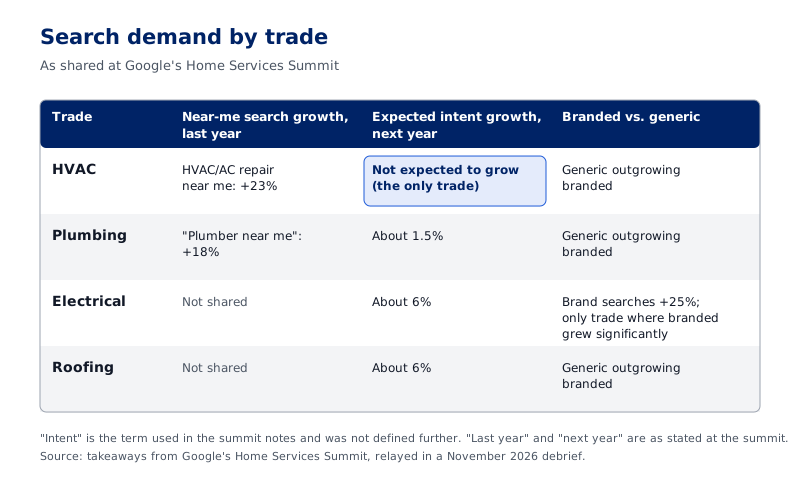
Key Takeaway: Google shared at its Home Services Summit that HVAC is the one trade not expected to grow in intent next year, and that generic searches are outgrowing branded ones almost everywhere. Strong service pages matter most when paid clicks get pricier and new customers don't know your name yet.
What Google Says It Wants From Your Content
Google released its November 2026 core update on November 10, and as of November 16, 2026, the Search Status Dashboard still showed it rolling out, with no end date posted. This section is about the longer view: what Google has said it wants, no matter which update is running.
At the summit, Google stated its content standard this way: "Create unique, non-commodity content with deep expert insights made for people first." Non-commodity means content that isn't interchangeable with what every other company publishes. Google's page on creating helpful, people-first content asks the same thing in question form. It asks whether your content provides "original information, reporting, research, or analysis," whether it provides "substantial value when compared to other pages in search results," and whether it shows "first-hand expertise and a depth of knowledge."
The same Google page lists what to avoid. It asks whether you are "using extensive automation to produce content on many topics," and whether you are "producing lots of content on many different topics in hopes that some of it might perform well in search results." Google's concern is scaled, low-value content made to manipulate rankings. One takeaway from the summit was to avoid fully automated AI content, because the signal points toward deep, expert, human-sourced content.
Where the expert insight comes from
Your techs and office staff answer customer questions every day, and that knowledge is exactly what generic content can't copy. One content takeaway from Google's Home Services Summit was for marketers to interview the businesses they work with on recorded calls, then repurpose those answers as YouTube clips and blog content. The same takeaway suggested embedding video on the relevant service and location pages.
For a home service company, the easiest version is a short recorded conversation with the owner or a lead tech. Ask something like, "Hey, what's the question customers ask you most on a water heater call?" Then build the page around the answer, in their words, and put the clip on that page.
Does Your City Page Pass the Swap Test?
In our experience, city pages are where a lot of home service sites cut corners. After Google's March 2026 core update, one local marketing agency wrote that if a site had 15 or 20 location pages that looked roughly the same, with just the city name swapped in, those pages likely lost rankings. That is an agency's read, not controlled data. Another local marketing firm that studied city pages noted that there is no public count of how many city pages fell.
That second firm offers a simple test. In its words, "A service area page survives 2026 only when swapping the city or the competitor's name makes it false." If you swap in a different town and every sentence still reads true, nothing on the page belongs to that town. If you swap in a competitor's name and it still reads true, nothing on the page belongs to your company either.
Here are four questions to ask about each city page you have:
- Does the page name places in that area, such as neighborhoods, ZIP codes or landmarks?
- Does it mention real jobs your team has done there?
- Are the photos taken in or around that area?
- Would the page become false if you swapped in another city or a competitor's name?
The first three come from the fixes the first agency recommended, and the last one is the swap test itself. If a page fails, it needs real local substance, not a new city name.
Why real businesses may have the edge
An SEO agency's analysis of the March 2026 update covered 2,076 domains. It found the top of the winner list was almost entirely "the company that owns the thing," while the top of the loser list was almost entirely "the platform people use to talk about the thing." In travel, it also suggested Google may be preferring sites where people can take a direct action, such as booking. That analysis did not include a home services dataset, so no one has confirmed the pattern for the trades.
Key Takeaway: By one local marketing firm's swap test, a city page earns its place only when swapping in another town or a competitor's name would make it false. Real jobs, real places and local photos are how you get there.
Frequently Asked Questions
Does Google penalize content because AI helped write it?
Google's guidance focuses on why and how content is made, not on the tool alone. Its page on helpful content says that can include "automated, AI-generated, and AI-assisted content." Where Google draws a hard line is automation used "for the primary purpose of manipulating search rankings," which it calls a violation of its spam policies. One takeaway from Google's Home Services Summit was to avoid fully automated AI content, because the signal points toward deep, expert, human-sourced content. However a page gets written, it still has to show what your company knows.
Should I update the dates on old blog posts so they look fresh?
Not unless the post changed in a real way. Google's helpful content page asks site owners whether they are "changing the date of pages to make them seem fresh when the content has not substantially changed." That question sits under Google's heading "Avoid creating search engine-first content." If a post is out of date, rewrite the parts that changed, such as prices, steps or rules, and then update the date.
What is Google's Preferred Source feature, and does it help rankings?
As described at Google's Home Services Summit, Preferred Source lets people bookmark sites as preferred sources. One hypothesis shared there is that more people choosing a site as a preferred source signals content quality and may improve rankings. That is a hypothesis, not something Google has confirmed, and none of the sources we checked proves it either way. Treat it as a small extra if your customers already like your content, not as a ranking plan.
Should I wait for the core update to finish before improving my content?
Google released its November 2026 core update on November 10, and as of November 16, 2026, the rollout was still in progress with no end date posted. Google's core updates page says you don't necessarily have to wait for a major core update to see the effect of your improvements, and it warns against "quick fix" changes. At ASP, we hold off on structural changes such as URL changes, mass deletes, template rewrites and redirect projects until a rollout ends. Normal publishing and bug fixes keep going.
How much does mobile matter for a home service website?
One takeaway from Google's Home Services Summit is that 70% of home service site traffic is mobile, and the advice was to put the mobile experience ahead of desktop looks. Check your most important pages on your own phone. Make sure the phone number and booking options are easy to tap, and that the page answers the question without a lot of scrolling past large images.
If my calls dropped, is my content the problem?
Not necessarily. Organic clicks in Search Console are where a core update effect shows up. Calls and direction requests in Business Profile Insights and your call tracking are where changes to Google's local results show up, such as a tested local pack inside AI Overviews without call buttons, or more ads in the 3-pack. If organic clicks hold steady while Business Profile calls fall, that points to Google's results layout, not a core update. Rewriting good pages won't bring back a missing call button.
Putting It to Work on Your Website
What Google wants from local content in 2026 isn't a trick. Search is growing, the questions are getting longer, and AI Overviews pull from the related questions around each search. Google says it wants unique, expert content made for people first, and its own pages list the shortcuts that work against you: mass automation, publishing in bulk and hoping, and fake freshness.
Start with three jobs. Pull your seven-word-plus queries from Search Console and answer them on the right service pages. Make sure each service page covers cost, availability and reviews. Then run the swap test on every city page and fix the ones that fail with real local proof.
At ASP, we judge content the same way we judge every channel: by the calls and booked jobs it brings in, measured by cost per booked job. If you want help building pages that earn those calls, talk with our team.
Frequently Asked Questions
Does Google penalize content because AI helped write it?
Should I update the dates on old blog posts so they look fresh?
What is Google's Preferred Source feature, and does it help rankings?
Should I wait for the core update to finish before improving my content?
How much does mobile matter for a home service website?
If my calls dropped, is my content the problem?

Joel Keith
CEO and Partner at ASP
Joel Keith is CEO and a partner at ASP, a growth-systems marketing agency for home service operators. He is a marketing operator who has spent years inside home service companies, building and refining the systems ASP now runs for clients. ASP is a Housecall Pro Affiliate.
Ready to Put This Into Action?
ASP can help you implement these strategies and build a marketing system that drives measurable growth.