Wondering which AI SEO advice is worth acting on when you run an HVAC, plumbing or other home service company? Neil Patel's YouTube video The 5 Rules of AI SEO for 2027 gives five tips for getting a website pulled into AI answers. He says to structure content so AI can pull it, let a human write the final version, stay in your own topic lane, manage what people say about you off your site, and answer the questions only an expert could answer. At ASP, a growth-systems marketing agency for home service operators, we agree with most of that advice, but we see some of the reasons behind it differently.
Neil Patel's video, The 5 Rules of AI SEO for 2027, on YouTube. Image: Neil Patel.
For a local business, we would put his fourth tip first: reviews and what people say about you. Below, we take each tip in turn. We cover what Patel says, where ASP stands, what Google has published and what a home service owner should do. It is the same thinking behind our answer engine optimization work.
How Patel's Tips Compare With ASP's View
Patel presents his five tips as the things that will get a website pulled into AI answers. We checked each one against what Google has published about its AI features and against how we approach SEO for home service companies. The table below shows where we land on each tip and what we would do about it.
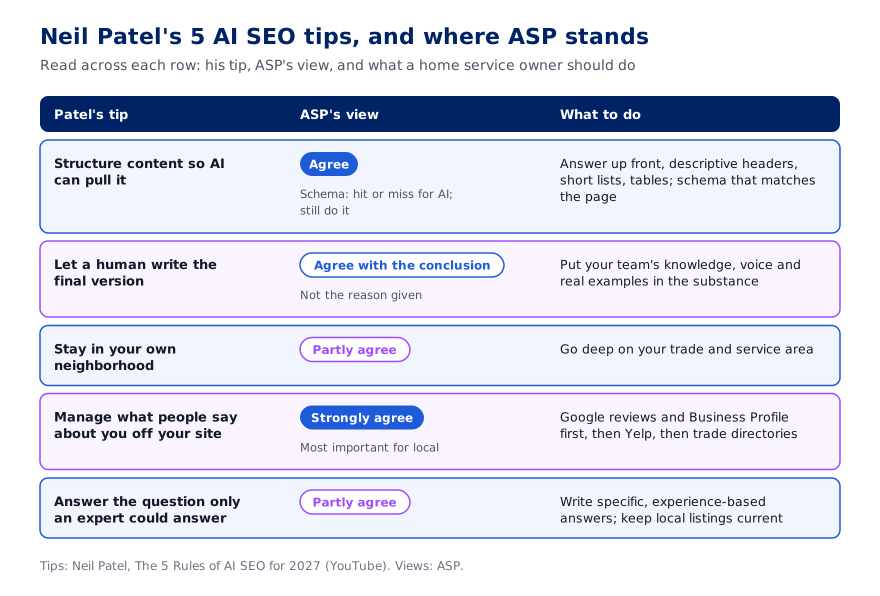
Read across each row: Patel's tip, where ASP stands, and what a home service owner should do.
We agree with his advice on structure and reviews. On human-written content, we agree with where he ends up but not with the reason he gives. We partly agree on topic lanes and expert questions, mostly because we see a different reason the advice works.
Key Takeaway: ASP would act on all five of Patel's tips, disagrees with some of the reasons he gives, and ranks reviews and mentions first for a local business.
Should You Structure Content So AI Can Pull It?
Patel's first tip is about how a page is packaged. In his video, he says AI engines read a site "like a journalist on a deadline," scanning for the clearest quote they can lift. His advice is "One clear point per header, one fact per bullet," with tables for anything with numbers and schema markup underneath it all. He cites a survey his team ran of a thousand marketers about which content types earned the most AI citations, and in that survey listicles and roundups came out on top with almost 22% of all citations.
We agree with the packaging advice. A page with the answer up front, headers that say what each section covers, short lists and tables for numbers is easier for people to use, and easier for AI tools to use too. Patel says the writer is "packaging differently with the same expertise," and that matches how we build pages. The knowledge stays the same; only the layout changes.
Schema markup is where we are more careful. As Joel Keith, ASP's CEO, puts it: "Schema is hit or miss and I lean for it more for traditional SEO but it's still important so it's something you should be doing." Google's guidance lines up with that. Its page on AI features in Search says "There's also no special schema.org structured data that you need to add," and its guide to optimizing for generative AI search adds, "However, it's a good idea to continue using it as part of your overall SEO strategy, as it helps with being eligible for rich results on Google Search."
The same AI features page includes this line about structured data: "Making sure your structured data matches the visible text on the page." For a home service site, that means the services, business details and FAQ answers in your markup should match what a visitor sees. Start with your service pages. Put the direct answer to the homeowner's question in the first lines, name the service and the town in your headers, and use a table when you compare options. Then add schema that matches the page, which is part of our SEO services.
Key Takeaway: Clear structure helps people and AI tools use a page, and schema is still worth adding for traditional SEO even though Google says no special markup is needed for its AI features.
Does AI Prefer Human-Written Content?
Patel's second tip is to let a human write the final version. He says "the AI models doing the citing prefer human-written content over AI-generated content." He backs the point with reader data from his team, which analyzed over 3,000 pieces of content across 100 companies. In that analysis, human-written content held readers for 2 minutes and 31 seconds on average, fully AI-written content for 1 minute and 54 seconds, and AI-written content edited by a human for 1 minute and 59 seconds.
His advice is to use AI for research, outlines and first drafts, and then have a person write or heavily rewrite the final version. He wants that version to carry the writer's own voice, opinions and "examples from real client work." He also says a light edit is not enough and that the human has to shape the substance.
We have not seen evidence that AI tools prefer human-written content for its own sake. The numbers Patel shares measure how long readers stayed on a page. They do not measure how often an AI tool cited that page, and the reader data does not answer the citation question.
What we see Google ask for is originality and first-hand experience. Its AI optimization guide says, "Don't just recycle what others on the internet have already said, or could easily be produced by a generative AI model." The same guide says, "Our AI systems take a look at a variety of sources, so it can be helpful to have a unique viewpoint that stands out." So we agree with where Patel ends up: an expert's knowledge, voice and real examples have to be in the substance of the page.
For a home service company, the expert is usually you or your senior technicians. The details that make a page original come from your own work, such as the questions homeowners ask on calls, what your techs find when they open up a system, and how you decide between a repair and a replacement. Those details are hard for another site to copy.
Key Takeaway: We don't see evidence that AI tools favor human writing on its own, but Google asks for original, first-hand content, so your team's real knowledge has to be in the substance of every page.
Why Depth in Your Trade and Service Area Helps
Patel's third tip is to stay in your own neighborhood. He says AI engines judge whether a site has any business talking about a topic in the first place. His example is close to home for our readers: a plumbing site publishing a marketing article, which he says is "highly likely to be ignored." He sums the tip up this way: "Your depth on the topic is more important than the range of the topics you can talk about every single time."
Before you write anything, he suggests asking "is this in my lane or am I wandering into someone else's neighborhood?" He then recommends covering the beginner questions, the advanced questions, the edge cases and the mistakes within one topic area.
We partly agree. Depth in one topic does help, but in our view it helps largely because AI tools often lean on search results to find sources. Google says its AI Overviews and AI Mode may use a "query fan-out" technique, "issuing multiple related searches across subtopics and data sources." Google also says that to be eligible as a supporting link in those features, "a page must be indexed and eligible to be shown in Google Search with a snippet."
Patel describes AI engines deciding whether a site belongs on a topic. Google's published guidance sets a different test: a page has to meet the indexing and snippet requirement described above before it can be a supporting link in AI Overviews or AI Mode. For a home service company, the lane is its trade and its service area. An HVAC company builds depth with service pages, city pages and blog posts about heating and cooling work in the towns it serves. General business-tips posts do little to show what you do or where you do it.
Key Takeaway: For a home service company, the topic lane is its trade and service area, and in our view depth there helps largely because AI tools often lean on search results, and Google can only link a page in an AI Overview or AI Mode answer if it is indexed and eligible to be shown in Search with a snippet.
Reviews and Mentions Matter Most for Local Businesses
Patel's fourth tip moves off your website. He says AI is weighing things you don't control directly, such as how often your brand gets mentioned, what your reviews say, and the tone of those reviews compared with your competitors' reviews. His example fits our readers. When someone asks ChatGPT "who's the best HVAC company in Phoenix?" he says it reads Reddit threads, review sites, forum posts, the Google Business Profile and Yelp, not just the company's website.
His team surveyed a thousand marketers on which outside signals AI trusts most. Customer reviews came out first, community recommendations from places like Reddit and forums came right behind, and industry awards came in last. "The trophy wall on your about page means almost nothing to machines," he says. His advice is to "Ask happy customers for reviews, respond to the bad ones," and to watch your mentions and review tone as closely as you watch keyword rankings.
We strongly agree with this tip, and we think it is the most important of the five for a local business. Where we differ is the label. Patel says "brand mentions and review sentiment are now ranking factors." We would not call them ranking factors in AI, but they do shape what AI tools say about you, and that is reason enough to work on them.
We work on review platforms in a set order. Google reviews and your Google Business Profile come first. Google's AI features page lists "Checking that your Merchant Center and Business Profile information is up-to-date" in its guidance, and its AI optimization guide says Business Profiles "can help your products and services to be visible in both AI responses and other Google Search results." Our post on Google Business Profile as an AI data source covers this in more detail.
Yelp comes next. MarTech reported on July 28, 2026, citing Axios, that "Yelp is licensing its reviews, ratings, photos, and other local business information to OpenAI." The report says that "When users ask ChatGPT for local recommendations, responses can include Yelp reviews, ratings, photos, and business details." It also says the companies plan to add Yelp's Request a Quote feature, and that the financial terms of the deal were not disclosed.
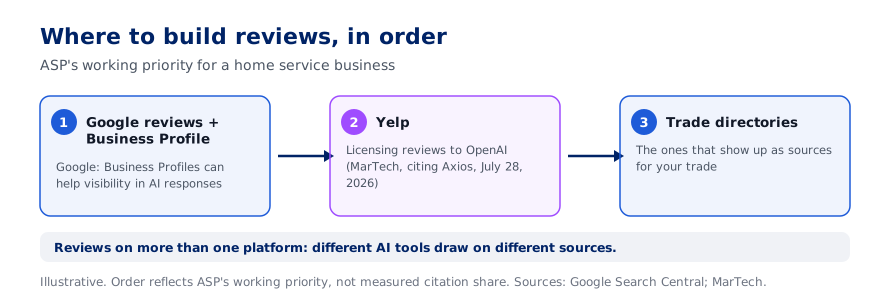
Illustrative: this order reflects ASP's working priority, not a measured share of AI citations.
After Yelp, we look at the trade directories that show up as sources for your trade. Reviews on more than one platform matter because different AI tools draw on different sources. This review and listing work is at the center of our generative engine optimization approach.
Key Takeaway: Reviews and mentions shape what AI tools say about a local business, so build reviews on your Google Business Profile first, then Yelp, then the trade directories that show up as sources.
When Does an AI Tool Look Up a Source?
Patel calls his fifth tip the one that matters more than the other four. He says simple, generic questions, such as what SEO is or which CRM is best, get answered from the AI model's training with no citation and no traffic to anyone. Specific, expert-level questions are different, he says, because the model reaches the edge of what it knows and has to find a real page written by a real expert. In his words, "Generic questions get answered from the model."
His example of an expert question is how a 12-location dental group should structure its CRM. His advice is to build content around the specific, complicated version of your topic, including "the question your best client asked you last month."
We partly agree. We agree with the writing advice, because specific answers based on real experience are worth more than another general explainer. Our view of when an AI tool looks up sources is different. We think it depends more on whether the answer needs current or local information than on how complex the question is.
In our view, a general question about how a heat pump works is the kind of question an AI tool can answer on its own. A question about which company to call for AC repair in your town needs current, local information, and that is where your reviews, Business Profile and listings come into play. Write pages that answer the specific questions your customers ask, and keep the local information behind those "who should I call" answers current and accurate.
Key Takeaway: Specific, experience-based answers are worth writing, and in our view local "who should I call" questions are where a home service company's reviews and listings come into play.
What Should a Home Service Owner Do First?
For an HVAC or other home service company, we would work through Patel's tips in this order:
- Build reviews where AI tools look. Start with your Google Business Profile and keep it current, then add Yelp and the trade directories that show up as sources for your trade.
- Ask for reviews and answer the bad ones. Patel advises asking happy customers for reviews and responding to the bad ones; do that on each platform above.
- Put your team's knowledge on the page. Use the questions, findings and judgment calls from real service calls in every service page and post.
- Structure each page. Put the answer up front, use descriptive headers, short lists and tables, and add schema that matches the visible text.
- Stay in your lane. Keep your content inside your trade and service area, and answer the specific questions your customers ask.
None of this comes with a guarantee. Google's AI optimization guide says "Indexing and serving aren't guaranteed," and no one outside these companies controls what an AI tool says. We go further into the research in what the evidence shows on GEO, and we explain one shortcut we don't sell in our post on llms.txt for local businesses.
Patel's video makes a useful checklist. For a local business, the work that matters most happens off your website, in the reviews and listings that AI tools can draw on. Once that is in place, well-structured pages built on your team's real experience give homeowners and AI tools more reasons to trust what they find.
Frequently Asked Questions
What are Neil Patel's 5 rules of AI SEO?
Do I need schema markup to show up in AI answers?
Do AI tools prefer content written by a person?
Why do reviews matter for AI answers about local businesses?
Does Yelp matter for ChatGPT?
Should an HVAC company blog about topics outside its trade?
Can ASP guarantee my business will show up in AI answers?

Joel Keith
CEO and Partner at ASP
Joel Keith is CEO and a partner at ASP, a growth-systems marketing agency for home service operators. He is a marketing operator who has spent years inside home service companies, building and refining the systems ASP now runs for clients. ASP is a Housecall Pro Affiliate.
Ready to Put This Into Action?
ASP can help you implement these strategies and build a marketing system that drives measurable growth.