Say someone calls your plumbing company from Local Services Ads, hears your phone menu and presses 1 for service. Google's 20-second timer just reset, and if that call keeps going for more than 20 seconds after the key press, you're charged for the lead. That's the 20-second rule in short. On Local Services Ads, a missed call during your business hours becomes a charged lead once the caller stays on the line for more than 20 seconds, and a phone menu changes when that clock starts.
ASP is a growth-systems marketing agency for home service operators. This guide covers how the rule treats phone menus, voicemail, hold music and answered calls, which follow-up calls aren't charged again, and the test I'd run on your own line this week. If your account is still moving over, start with what changes when Local Services Ads move to Google Ads. Google's rules here follow its help pages as we checked them on November 16, 2026.
What Counts as a Charged Call on Local Services Ads
Local Services Ads bill by the lead, not the click. Google's page on the move to Google Ads says you still only pay for valid leads, such as phone calls and messages, rather than ad clicks. So the question that matters for your budget is which calls Google counts as valid.
Google's help page on how leads work spells out the call scenarios. A call is a valid lead when you answer it, or when you call the customer back and speak with them. A missed call also counts if it comes in during your business hours and the caller stays on the line for more than 20 seconds. If you've set an ad schedule that's different from your business hours, Google only charges unanswered calls that come in during your active ad schedule and within your business hours. A voicemail from the customer is on Google's list of valid leads too.
Answered calls don't run on the ring clock
Google says the 20-second ring rule applies only to unanswered calls. If you or someone at your business answers the phone, even after 20 seconds of ringing, you aren't charged based on the ring time. Instead, the call is judged as an answered call, based on your conversation with the customer.
That tells you where the rule bites. It's about the calls nobody picks up. A caller who waits through the ringing and gives up after more than 20 seconds during business hours is still a charged lead, and nobody on your team got the chance to book the job.
How the 20-Second Rule Treats a Phone Menu
A phone menu, the automated system that asks callers to "press 1 for service," changes when the clock starts. Google's help page lays out the rule. If your menu asks the caller to press a key and they hang up without pressing one, you aren't charged, even if the menu played for more than 20 seconds.
Once the caller presses their first key, the 20-second timer resets. You're charged if the call continues for more than 20 seconds after that first press. Google says additional key presses in multi-level menus don't reset the timer again, so the time a caller spends in a second or third menu counts.
A worked example
Here's a made-up example to show the math. A caller hears a 10-second greeting and presses 1 for service. They spend 12 seconds in a second menu, press 3 for repairs, then wait 15 seconds and hang up before anyone picks up. That's 27 seconds since the first key press, so during business hours, that call meets Google's rule for a charge.
Now take the same caller and have them hang up during the greeting, before pressing anything. Under Google's rule, that call isn't charged. The difference is that first key press. Once it happens, the clock is running, and the menus after it don't buy you more time.
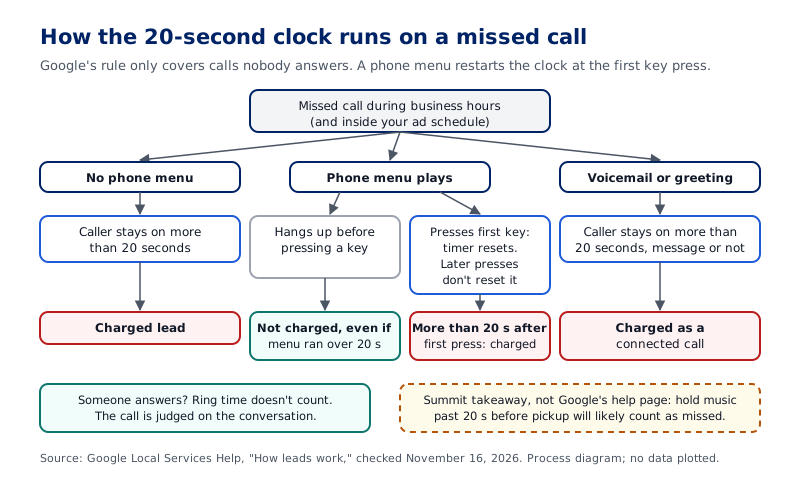
Key Takeaway: The first key press restarts the 20-second clock, and nothing after it restarts it again. Every second of the call after that press counts, including the time spent in deeper menus.
Voicemail, Automated Greetings and Hold Music
It's easy to assume voicemail is free, but Google's help page says otherwise. If a call goes to voicemail or an automated greeting during your business hours, Google treats it as a connected call. It's charged if the caller stays on the line for more than 20 seconds, whether or not they leave a message.
Picture a busy morning. A customer calls, nobody's free, and the call rolls to voicemail. The customer listens to your greeting, decides not to leave a message and hangs up. If that took more than 20 seconds during business hours, you paid for the lead, and nobody on your team talked to that customer.
What Google's Home Services Summit added about hold music
Google's help page on how leads work doesn't mention hold music by name. One takeaway from Google's Home Services Summit is that hold music running past 20 seconds before pickup will likely count as a missed call. That comes from the summit, not from Google's help pages, and the word "likely" is part of it.
Google's menu rule points the same way. Once the first key is pressed, the help page says you're charged if the call continues for more than 20 seconds after it, and the page doesn't set hold time apart.
The same summit takeaway included a target for menus: keep the menu to 15 seconds or less before it gets the caller to a live person. The shorter the path from the first key press to a person, the less of those 20 seconds goes to recordings and hold music.
Here's how each situation lines up, based on Google's help page and that one summit takeaway:
| What happens on the call | How it's treated |
|---|---|
| Someone at your business answers | Not charged on ring time; judged as an answered call |
| No menu, nobody answers, caller stays on more than 20 seconds | Valid lead during business hours |
| Menu plays and the caller hangs up without pressing a key | Not charged, even if the menu ran past 20 seconds |
| Caller presses a key and the call continues more than 20 seconds after that first press | Charged |
| Caller presses more keys in deeper menus | Timer doesn't reset again |
| Call goes to voicemail or a greeting and the caller stays on more than 20 seconds | Charged during business hours, message or not |
| Hold music runs past 20 seconds before pickup | Summit takeaway: will likely count as a missed call |
Key Takeaway: During business hours, Google treats voicemail as a connected call. A caller who listens to your greeting for more than 20 seconds is a charged lead, even if they never leave a message.
Follow-Up Calls Within 15 Days Aren't Charged Again
Here's the part of the rule that works in your favor. Google says that once a lead is charged, follow-up calls or messages with that customer aren't charged again, as long as there's interaction within 15 days and the contact comes from the same phone number or email address. If 15 days pass with no activity, a new call or message from that customer creates a new lead, and it's charged if it meets the valid lead rules.
That changes how to think about a missed call you already paid for. The charge is already on the books, and follow-up calls and messages with that customer inside the 15-day window, from the same number or email, don't add another one. What's left to win is the job, which is why a fast callback matters. Our guide to speed to lead for home service businesses explains how slow responses to inbound calls cost home service companies revenue.
What if you miss a short call?
A call that rings for less than 20 seconds before the caller hangs up doesn't meet the missed-call rule on its own. Google's help page says that if you call the customer back and speak with them, that's a valid lead, and follow-up calls are judged by the rules for an answered call. You're charged once, on the first call that qualifies as a valid lead, and not again for later calls on that lead within 15 days.
So a callback can turn that short call into a charged lead. That charge comes with a real conversation with someone who called you for help, which is the whole reason to pay for leads in the first place.
Call Your Own Number This Week
The quickest way to know where you stand is to hear what your customers hear. Here's what I'd do this week, during business hours:
- Time the menu. Start a timer when the greeting begins, note when you can first press a key, and keep timing from that first press until a person answers. The summit takeaway target is 15 seconds or less before a caller reaches a live person.
- Time the hold. If a caller can wait more than 20 seconds after that first press with nobody picking up, that call already meets Google's charge rule during business hours. The summit takeaway also says hold music past 20 seconds will likely count as a missed call.
- Let it go to voicemail. Time how long your greeting runs. During business hours, a caller who stays on more than 20 seconds is a charged lead, message or not.
- Check where calls ring. Google says you can edit the phone number your call and message leads are routed to in Google Ads, so confirm it rings on a line someone answers.
- Check your hours. Google uses the hours on your Google Business Profile as your business hours for this rule, so they should match the hours someone can pick up.
If the test leaves you asking, "why does it take this long to reach a person?", fix that path before you touch the budget. Shorten the greeting, cut a menu level or send ad calls straight to whoever books jobs.
At ASP, we judge every channel by cost per booked job. A charged lead that never reached a person adds cost without a chance at a job, so the phone path is part of that math. Our guide to marketing attribution for home service businesses explains how to connect each booked job back to the channel that produced it, and our guide to how Local Services Ads work inside Google Ads covers the weekly side of running the campaign.
Key Takeaway: Once that first key gets pressed, the clock is running. Time your menu, your hold and your voicemail greeting, and make sure somebody picks up.
Frequently Asked Questions
Does the 20-second rule still apply after my account moves to Google Ads?
Yes, based on Google's help pages. Google says Performance Max campaigns with pay-per-lead goals are built on the same models as Local Services Ads and share the same framework for sourcing valid leads. Its page on pay-per-lead goals says the required phone call goal tracks answered calls, voicemails and return calls to missed connections, and that you're only charged for valid, qualified phone leads that meet minimum call duration requirements. For the details, that page refers you to Google's help page on how leads work, and the Local Services version of that page describes charge statuses on the Leads page in Google Ads.
What does Google count as business hours for missed calls?
Google says business hours are the hours you set in your Google Business Profile, and you can update them at any time. If you've set an ad schedule that's different from your business hours, unanswered calls are only charged when they happen during your active ad schedule and within your business hours. In Google Ads, your hours sync one way from your Business Profile, so you change them on the profile, not in the campaign. Keep those hours honest, so the profile shows you open when someone is there to answer.
Can I dispute a call I don't think I should have paid for?
Not the old way. Google's transition page says manual lead disputes are no longer supported in Google Ads. Google says it keeps assessing lead quality over a 30-day period and automatically applies a credit when a lead is found to be poor quality, a duplicate or invalid. You can also share feedback on individual leads through the survey on the Leads page, which Google says it uses to improve its models and processes over time. One takeaway from Google's Home Services Summit is that lead rating is available right away under Goals > Leads, and that rating leads can result in credits for incorrectly charged leads.
Where can I see whether a call was charged?
On the Leads page in Google Ads. To get there, open the Goals menu, click Conversions and choose Leads. Google says that is where your lead inbox and call recordings now live. Each lead has a Charge Status column marked Charged, Not charged, In review or Credited. Checking a few charged calls against their recordings is a practical way to see whether menu and voicemail calls are costing you leads.
Can I change the phone number my Local Services Ads ring?
Yes. Google says that in Google Ads you can edit the phone number your call and message leads are routed to, in real time. Your business phone number is pre-filled from your Google Business Profile, but you can edit it in your campaign settings. If ad calls currently land on a line with a long menu or a shared voicemail, a more direct line to whoever books jobs is worth considering. Test any new number the same way: call it and time it.
Is a text lead priced the same as a call?
Usually not. Google says message leads are typically priced lower than the matching phone lead, although that's not always the case. The price of a message lead is based on the customer's estimated likelihood to book your business, using factors such as the message lead type, the service requested, whether the customer has contacted other Local Services advertisers and their past engagement with the ads. Texts and emails are optional lead types, while phone calls are required. If you turn messages on, answer them as quickly as you answer the phone.
Make Sure Somebody Picks Up
The 20-second rule is simple once you see where the clock starts. Answered calls aren't charged on ring time. A missed call during business hours is charged once the caller stays on for more than 20 seconds, a phone menu restarts that clock at the first key press, and voicemail counts as a connected call. One takeaway from Google's Home Services Summit adds that hold music past 20 seconds before pickup will likely count as a missed call.
Most of what decides those charges lives on your own phone line, not in your ad settings. Call your own number, time the menu, the hold and the voicemail greeting, and shorten the path from the first ring to a person who can book the job. Then judge the campaign by what it costs you per booked job.
If you want help tying your Local Services Ads calls to booked jobs, talk with our team.
Frequently Asked Questions
Does the 20-second rule still apply after my account moves to Google Ads?
What does Google count as business hours for missed calls?
Can I dispute a call I don't think I should have paid for?
Where can I see whether a call was charged?
Can I change the phone number my Local Services Ads ring?
Is a text lead priced the same as a call?

Joel Keith
CEO and Partner at ASP
Joel Keith is CEO and a partner at ASP, a growth-systems marketing agency for home service operators. He is a marketing operator who has spent years inside home service companies, building and refining the systems ASP now runs for clients. ASP is a Housecall Pro Affiliate.
Ready to Put This Into Action?
ASP can help you implement these strategies and build a marketing system that drives measurable growth.