If your home service company is getting fewer calls from Google this month, don't blame the core update yet. Google confirmed a core update on November 10, 2026, and it is real, but its effect shows up in organic clicks in Search Console. Two other changes in Google's local results show up in calls instead. One is a test of a local pack inside AI Overviews that has no call button. The other is the growth of ads in the local 3-pack and of Local Services Ads (LSAs) on local searches.
ASP is a growth-systems marketing agency for home service operators. This post walks through both suspects and the split we use to tell them apart, so you fix the thing that moved your numbers. Everything here follows the sources as we checked them on November 16, 2026.
Why the Core Update Is Not the Only Suspect
Google's Search Status Dashboard entry for the November 2026 core update shows the update starting on November 10, 2026 at 10:06 a.m. Pacific time. Google's entry says the update applies globally and to all languages, and that the rollout may take up to two weeks to complete. As of November 16, 2026, the dashboard had not posted an end date, so the update was still rolling out when we wrote this.
Google hasn't said what this update targets. Google Search Central described it as "a regular update designed to better surface relevant, satisfying content for searchers from all types of sites." Launch coverage from a search industry publication found no Search Central blog post and no new guidance to go with it.
Where an update shows up matters more than how big it is. Organic clicks in Search Console are where a core-update effect shows. Calls and directions in Business Profile Insights, and the call sources in your call tracking, are where the other two changes show up. Those are two different places to look, and they can tell two different stories.
Here's the trap. It's easy to look at a slow week and say, "Hey, our calls are down, let's rewrite the website." If the drop came from what Google shows on its results page rather than from your rankings, rewriting the website may not fix it.
The First Suspect Is a Local Pack Inside AI Overviews
On November 10, a local search researcher documented a test of a local pack inside AI Overviews on mobile. The test version strips out the call button, the directions button and the website button, along with reviews and photos. The researcher wrote, "On mobile, every time I get this version, the traditional local pack is gone."
Another industry tracker replicated the test and said this version "cannot be good for clicks, calls and direction actions to businesses." As of November 12, Google hadn't commented, and there was no data on how widely the test was showing. The test is a change to how Google lays out local results, separate from the core update.
Picture a homeowner with a leaking water heater searching on a phone. If the version they see has no call button, there is no button on that result that dials your number. Your website and your Business Profile could be in great shape, and that result still would not have a call button on it. Rewriting a service page may not change that.
The Second Suspect Is More Ads in the 3-Pack and More LSAs
A local SEO firm that tracks Google's local results has watched paid listings take up more of the local 3-pack, the map listings that show near the top of local searches. At the start of 2025, ads showed up in the 3-pack on about 1% of the mobile reports the firm was running. By December 2025, that figure was about 22%. Local Services Ads went from showing on about 11% of the queries the firm tracked at the start of 2025 to 31% by November 2025.
Those are the firm's own tracked reports, not a count of every search in your market. In the firm's data, though, ads in the local pack went from rare to showing up in more than one in five mobile reports. If you're competing for the same jobs, those listings sit in the space where a customer decides who to call.
If you run Local Services Ads yourself, their move into Google Ads is a separate change on the paid side. Google's help page on the transition says these ads will continue to show exclusively on Google Search and Google Maps, in the same ad positions as before. One takeaway from Google's Home Services Summit is that LSA ads are expected to appear below AI Overviews in search results. Our guide to how Local Services Ads work inside Google Ads covers where those leads land after the move.
What we're checking at ASP
At ASP, we're spot-checking each client's top three to five money searches on a phone. Money searches are the ones that bring in paying work, such as a repair service plus a city name. We look for the AI local pack, for ads in the 3-pack and for LSAs, and we screenshot what we find. A screenshot gives you a dated record of the results page that you can line up against your call numbers later.
Key Takeaway: The AI Overviews local pack test and the growth of ads in the 3-pack both show up in calls, not in organic clicks. Screenshot your own top searches on a phone so you know which of them you're up against.
How Do You Tell Which Change Moved Your Calls?
The answer comes from two sets of numbers that you keep apart. One set tells you about your organic rankings. The other tells you about calls that came through Google's local results. If you mix them into one "Google" number, you can't tell which change moved.
Start with a clean comparison week. At ASP, we're locking Monday, November 2 through Sunday, November 8 as the baseline. That week skips November 9, which had some movement before Google announced the update.
Then pull these numbers for the baseline week and for each week since:
- Organic clicks in Search Console, filtered to Web search. This is where a core-update effect shows.
- Calls and direction requests in Business Profile Insights. This is where the AI local pack and ads effects show.
- Call sources in your call tracking, so each call is tied to where it came from.
- Booked jobs from your field software, so you can see what a change cost you in paid work.
We also check the Manual Actions report in Search Console for every client. That rules out a cause that has nothing to do with the update.
Reading the two sets side by side
If organic clicks are holding steady and your Business Profile calls are falling, that's a layout problem on Google's results page. It's not the core update. If organic clicks fall while Business Profile calls hold, the core update is the first place to look. If both fall, more than one thing may be going on, including the usual holiday slowdown, so check each side separately.
Rankings often swing while a rollout is in progress, so treat November's organic numbers as early. The FAQ below covers when Google says to read them.
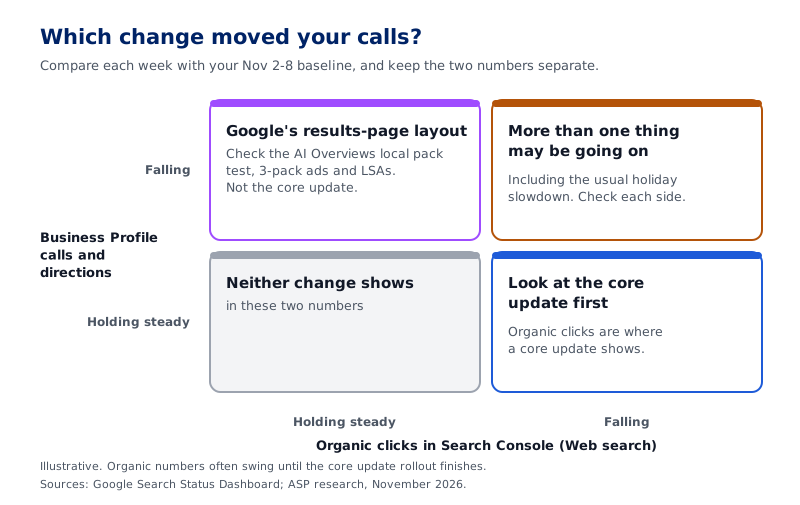
Key Takeaway: When organic clicks hold steady and Business Profile calls fall, look at Google's results page, not the core update. Keep the two sets of numbers separate so you can see which one moved.
Why the Fix Depends on Which One Moved
From an operator standpoint, these are different problems with different fixes. A core-update drop is about how your pages rank. A layout drop is about what Google shows around your listing. Mixing the two leads to the wrong fix, such as rewriting pages that were fine while the real cause sits on Google's results page.
That's why we tell clients plainly when a call decline traces to Google's local layout rather than the update. It changes what we work on next. It also keeps everyone from spending a month on the wrong project.
Judge the drop by booked jobs
Calls are not the finish line, though. At ASP, every channel is judged on cost per booked job, and a November call drop gets the same test. Our guide to marketing attribution for home service businesses explains how to connect each booked job back to the channel that produced it. Once you can see that, you know whether the calls you lost came from a source that books well or one that rarely turns into paid work.
The calls you still get matter more when volume dips. A slow pickup or a late callback can cost you a job no matter what Google changed, and our post on speed to lead for home service businesses walks through that math. For the Business Profile side, our local SEO playbook for home service businesses covers how local results work. Our comparison of where to invest first between your Business Profile and your website helps when you're deciding where the next dollar goes.
Key Takeaway: Judge a November call drop by booked jobs, not call counts alone. A layout problem and a ranking problem need different work, so find the cause before you pay for a fix.
Frequently Asked Questions
Has the November 2026 core update finished rolling out?
Not as of November 16, 2026. Google's Search Status Dashboard shows the update began on November 10, 2026 at 10:06 a.m. Pacific time, and Google said the rollout may take up to two weeks. No completion had been posted when we checked. A full two-week run would end around November 24, but some core updates run longer. The December 2025 core update took about 18 days, and one industry tally puts the median rollout across 23 core updates since 2019 at 14 days. Watch the dashboard for the posted end date.
When can I tell whether the core update affected my website?
Google recommends waiting at least a full week after a core update completes before analyzing your site in Search Console, then comparing a week after the update with a week before the rollout began. If the rollout ends on November 24, the earliest real read is about December 1. Thanksgiving falls in that first clean week, so at ASP we repeat the comparison for December 1 through 7 against November 2 through 8 and add a year-over-year check. If the rollout runs longer, each of those dates moves later by the same number of days.
Is this the Panda update people are talking about?
Google hasn't called it that. The Panda-level label is industry speculation that traces to an October forecast, and as of November 12 nothing measured justified it. On November 11, one analyst who tracks core updates said it was less than one day into the update, with little to report. For scale, Google said in 2011 that the original Panda change noticeably affected 11.8% of its queries. No comparable figure had been published for the November 2026 update as of November 12.
Should I make big changes to my website while the update rolls out?
At ASP, we're freezing structural changes until the rollout finishes. That means no URL changes, mass deletes, template rewrites or redirect projects, while normal publishing and bug fixes keep going. Google's own guidance says there's no need for drastic action for small drops, advises against quick fix changes and calls deleting content a last resort. In our view, a change made mid-rollout also makes it harder to tell what moved your numbers.
Can a core update hurt my map pack rankings?
It can happen, but the map pack runs on its own local ranking system, and past cases show map pack rankings holding while organic traffic falls. A summary of one local SEO firm's work describes businesses that lost more than 90 percent of their organic traffic while their Business Profile kept top map pack spots, and in one 2023 case, local pack changes arrived about two weeks after organic changes. That is a past pattern, not a finding about this update. As of November 12, no local-specific data on the November 2026 update had been published, so check your map pack numbers rather than assume.
Can my website gain before the next core update?
Yes. Since December 2025, Google has documented that site owners who make content improvements can see a rise in position in Google Search results without having to wait for the next major core update. Google also says recovery after a drop could take several months, with no guarantee. That makes steady improvement to the pages your customers rely on a better bet than a rush job in the middle of a rollout.
Find the Cause Before You Change Anything
Google's November core update is real, and as of November 16, 2026, it was still rolling out. Its effect shows up in organic clicks. A drop in calls can come from somewhere else: a test of a local pack inside AI Overviews with no call button, or more ads in the 3-pack and more LSAs on local searches. Those are different problems, and they need different fixes.
So lock a baseline week and keep Search Console separate from Business Profile Insights and your call tracking. Screenshot your top searches on a phone, then read every change against booked jobs. Google core updates may get the big headlines, but your call numbers may be telling a different story.
If you want help sorting out what moved your calls and what it means for your booked jobs, talk with our team.
Frequently Asked Questions
Has the November 2026 core update finished rolling out?
When can I tell whether the core update affected my website?
Is this the Panda update people are talking about?
Should I make big changes to my website while the update rolls out?
Can a core update hurt my map pack rankings?
Can my website gain before the next core update?

Joel Keith
CEO and Partner at ASP
Joel Keith is CEO and a partner at ASP, a growth-systems marketing agency for home service operators. He is a marketing operator who has spent years inside home service companies, building and refining the systems ASP now runs for clients. ASP is a Housecall Pro Affiliate.
Ready to Put This Into Action?
ASP can help you implement these strategies and build a marketing system that drives measurable growth.