A home service website has one job: turn a visitor into a booked appointment. Five things make that happen — page speed under 2 seconds on mobile, trust signals visible above the fold, call tracking on every CTA, dedicated service-area pages with schema markup, and mobile-first design with sticky call buttons. Sites that nail those five book at 8–15% of qualified visitors. Sites that miss two or three book at 1–3%, which means most marketing dollars driving traffic to those sites are wasted before the homeowner even decides whether to trust the business. This post walks through what actually drives conversion, what doesn't, and what really sets the cost of a site that books jobs.
The cost of a thin website isn't usually an obvious line item. It shows up as paid media that produces leads but not booked jobs, organic traffic that bounces, and a phone that rings less than the search volume in your service area says it should. Operators who fix the website usually see the rest of their marketing start working better, because the conversion floor stops eating every visitor sent to it. It's the Web Development component of our Growth System, explained the way we'd run through it on a working call.
The five things that actually drive conversion
These aren't trends. They're the structural pieces of a home service site that books jobs, in roughly the order of impact.
1. Page speed under 2 seconds on mobile
Conversion rate drops sharply past 2.5 seconds load time on mobile. Most legacy WordPress sites built without performance focus load in 4–8 seconds — meaning half the paid media budget is failing before the page finishes rendering. Google's Core Web Vitals documentation is clear that LCP (largest contentful paint), FID (first input delay), and CLS (cumulative layout shift) all directly affect rankings and conversion. Modern frameworks like Next.js, properly configured, hit sub-1.5 second mobile load times by default. WordPress can match this, but only with disciplined performance work most agencies skip.
2. Trust signals above the fold
Phone number, review count plus rating, service area, years in business, license or certification info. All visible without scrolling. A homeowner who lands on the page should know in three seconds — who you are, where you serve, and that you're credible. Operators chronically underestimate how brutal the first-impression test is. Adding the right above-the-fold trust signals to a thin homepage routinely lifts conversion 30–50% before any other change.
3. Call tracking on every CTA
If you can't tell which marketing channel drove each phone call, your attribution is broken from the front door. Dynamic number insertion, paired with a call tracking platform like CallRail or WhatConverts, captures the source of every call and ties it back to the CRM. Most paid traffic books by calling, so without call tracking you have no idea which campaigns are working. Our piece on marketing attribution for home service businesses covers the full attribution layer this connects into.
4. Service area pages plus schema markup
One real page per major city you serve, with LocalBusiness schema, embedded Google Map, and original copy that references local landmarks or service nuances. This is how one website ranks across multiple metros without spinning up separate sites for each. Service area pages without schema or with thin copy ("we proudly serve [City]") rank for nothing. Done right, the same site can rank in 10–20 cities, each capturing localized search intent.
5. Mobile-first everything
Over 70% of home service traffic is mobile, higher for emergency categories. Mobile-first means a sticky call button on every page, click-to-call phone links, one-thumb form completion, large tap targets, and content stacked vertically for the way thumbs scroll. A desktop-first site "made responsive" usually fails on at least three of these and converts mobile traffic at 2–3x lower than a true mobile-first build.
Key Takeaway: Page speed gates everything. Trust signals close the first impression. Call tracking makes attribution possible. Service-area pages plus schema unlock multi-metro ranking. Mobile-first design captures the majority of traffic. Skip any one and the rest underperforms.
What we build at ASP
We build high-performing websites engineered around three things: conversion rate optimization (CRO) so visitors turn into booked jobs, search engine optimization (SEO) so the right homeowners find you, and answer engine optimization (AEO) so you show up in AI-powered results. The five fundamentals above are baked into every build — whether it's a focused refresh of a site that's fundamentally sound or a ground-up custom build, scoped to what your business actually needs rather than a fixed package.
Every site we ship is owned by the client from day one. The Ownership promise applies here more than anywhere — domain, source code, design files, hosting credentials. All yours, written into the onboarding contract. No "we own the design files" gotchas, no platform lock-in, no surprise hostage situations if you ever leave.
Common mistakes home service operators make with their websites
The patterns we see in audits, in rough order of frequency.
- Slow site, no diagnosis. Operator knows the site is slow but doesn't know what's causing it (heavy theme, unoptimized images, render-blocking scripts, bloated plugins). The fix lives in the diagnosis, not the symptom.
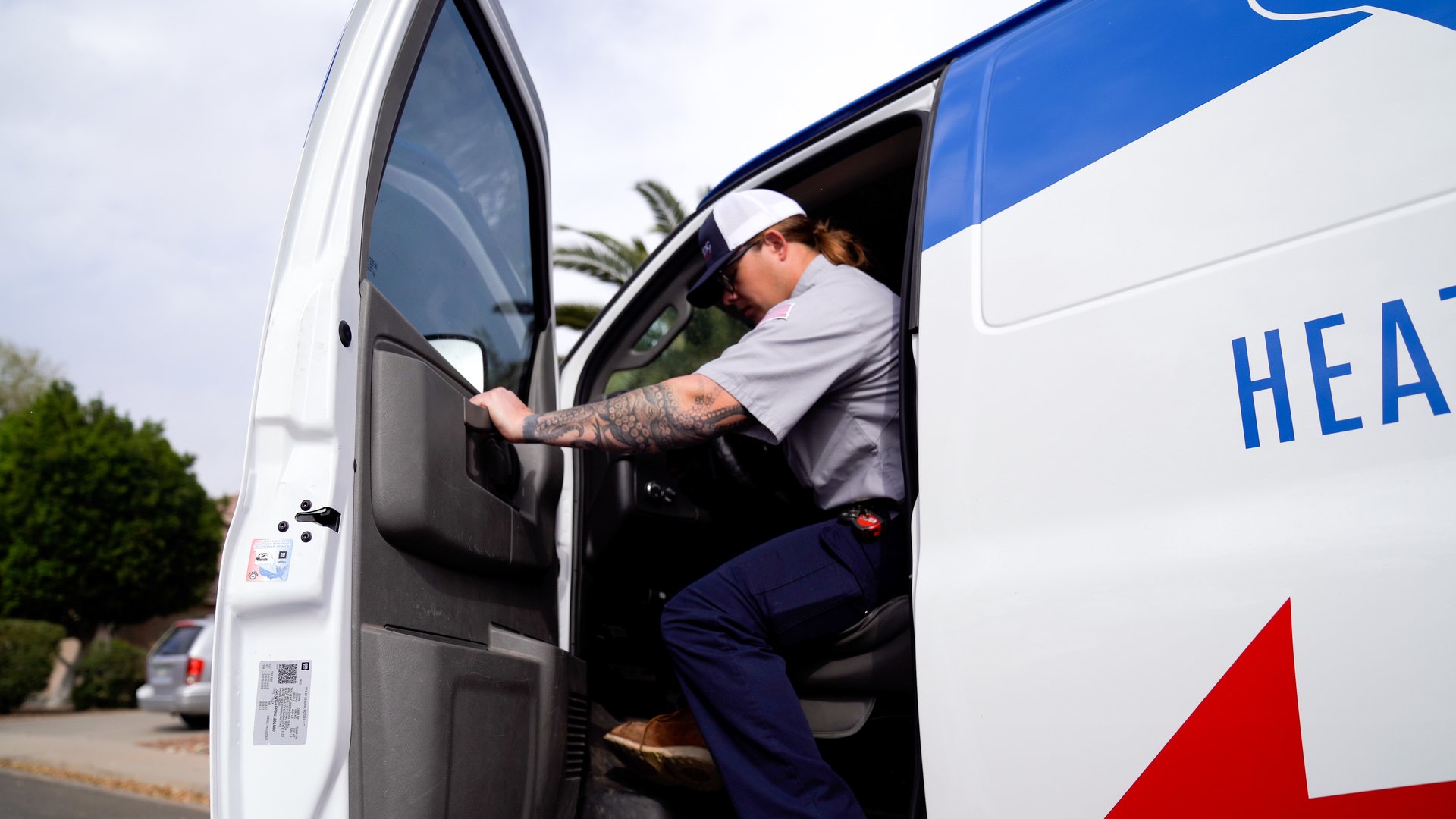
- Stock photography on every page. Generic stock undermines premium positioning. Real photos of your trucks, techs, and completed work consistently outperform stock images, even if the stock looks more "polished."
- Service area page that lists 50 cities. Ranks for nothing. One real page per service area is the pattern that earns rankings.
- One generic CTA across every page. Sending a homeowner who came looking for "tankless water heater installation" to a "contact us" form loses the specificity that drove the click. Service-specific CTAs convert dramatically better.
- No schema markup. Common in legacy WordPress sites. Easy to fix and high-leverage for both SEO and AI Overview visibility.
- Forms that ask for too much. Every required field reduces conversion. Most home service forms only need name, phone, service type, and zip — five fields max. Asking for more doesn't qualify the lead better, it just kills volume.
- No follow-up automation on form submissions. Form fills with no auto-response, no next-day reminder, no SMS follow-up lose 30–50% of bookable leads to delayed contact.
Any one of these alone will cap conversion. Two or three together explain why a site with decent traffic produces almost no booked work.
What a converting website costs
Website cost comes down to scope, not your revenue. A focused refresh of a site that's fundamentally sound costs far less than a ground-up custom build, and the variables that actually move the number are what the build has to do: how many service and service-area pages, how much custom design and copywriting, what integrations and attribution wiring, and whether there's ongoing CRO and content after launch. A single-service operator in one market is a different scope than a multi-service, multi-market build — and that's a scoping question, not a function of what you bill.
The honest way to get a real number is a short conversation about what the site needs to do. Pairs naturally with our piece on GBP vs. website investment priority when you're deciding where the next dollar goes.
Key Takeaway: A website's cost is set by scope — the pages, design, integrations, and ongoing work the build requires — not by a revenue tier. Get a real number from a quick scoping conversation, not a price grid.
How the website fits the Growth System
A website alone doesn't grow a home service business. A website connected to the full Growth System — paid media feeding it, local SEO ranking it, social media building recall around it, follow-up automation working the leads it produces, AI reporting attributing the revenue — that's when a website earns its keep.
The leverage isn't the site in isolation. It's the site as the conversion floor for every other channel. Fix the floor, every channel starts converting at higher rates. Don't fix the floor, every channel keeps producing leads that never book.
Common questions
What makes a home service website convert?
Five things: page speed under 2 seconds on mobile, trust signals above the fold, call tracking on every CTA, service-area pages with schema, and mobile-first design.
How fast does a home service website need to load?
Under 2 seconds on mobile, ideally under 1.5. Past 2.5 seconds, conversion drops sharply.
Should home service businesses use WordPress or a modern framework?
WordPress is fine for established sites without aggressive growth goals. Modern frameworks usually pay for themselves in conversion rate within 3–6 months once paid media spend is significant.
What trust signals do home service websites need above the fold?
Phone number, review count plus rating, service area, years in business, license info — all visible without scrolling.
Do home service websites need schema markup?
Yes. LocalBusiness schema, service-specific schema, BreadcrumbList, and FAQPage where they apply. Cheapest SEO win available.
How important is mobile-first design for home service websites?
Critical. Over 70% of traffic is mobile. The conversion gap between mobile-first and desktop-first sites is usually 2–3x.
How long does it take to build a home service website that converts?
Four to six weeks for a custom build, two to three weeks for a refresh. Faster usually means cut corners.
Conclusion
A home service website that converts isn't an act of taste. It's a structural decision about page speed, trust signals, attribution, schema, and mobile design. Operators who get those five right turn every other marketing channel into a multiplier. Operators who don't keep paying for traffic that bounces. The website is the floor everything else stands on, and a low floor caps the whole system.
If you want to see how your current site stacks up on the five fundamentals, run the Growth Diagnostic or contact ASP to walk through the Web Development component of our Growth System. No decks, no pressure — just a working session on whether the site is the bottleneck on your next stage of growth.
Frequently Asked Questions
What makes a home service website convert?
How fast does a home service website need to load?
Should home service businesses use WordPress or a modern framework?
What trust signals do home service websites need above the fold?
Do home service websites need schema markup?
How important is mobile-first design for home service websites?
How long does it take to build a home service website that converts?

Joel Keith
CEO and Partner at ASP
Joel Keith is CEO and a partner at ASP, a growth-systems marketing agency for home service operators. He is a marketing operator who has spent years inside home service companies, building and refining the systems ASP now runs for clients. ASP is a Housecall Pro Affiliate.
Ready to Put This Into Action?
ASP can help you implement these strategies and build a marketing system that drives measurable growth.